Islam is the real positive change that you need to change for being a better person or a perfect human being, you can change yourself if you read QURAN, IF YOU DO THAT !! you will change this UMMAH, say I am not A Sunni or Shia, BUT I am just a MUSLIM. Be a walking QURAN among human-being AND GUIDE THEM TO THE RIGHT PATH.
قالت صحيفة نيويورك تايمز الأميركية إن طهران تلقت التهديدات الأخيرة من الرئيس الأميركي دونالد ترمب باتزان مثير للدهشة، لأن إدارته أظهرت عمليا استعدادها للقيام بعمليات تجارية مع إيران.
وذكرت الصحيفة أن إيران تنتظر تسلم أسطول من طائرات بوينغ الأميركية، عقب صفقتين بقيمة 22 مليار دولار مع الشركة الأميركية.
وأضافت أن آخر عقد وُقع بين الشركة الأميركية وطيران إيران "أسيمان" كان بعد شهرين من تولي الرئيس ترمب مقاليد الرئاسة.
وتضيف الصحيفة أن ترمب الذي كانت حملته الانتخابية تقوم جزئيا
على إحياء العمالة الصناعية، لم يكن حريصا على إلغاء الاتفاق الذي سيوفر
18 ألف فرصة عمل في الولايات المتحدة.
ووفقا لنيويورك تايمز، سيكون من الصعب على الولايات المتحدة
حل المشكلات في لبنان وسوريا العراق واليمن من دون إيران، مشيرة إلى أن
الأعمال ستفتح قنوات اتصال مع طهران.
يشار إلى أن ترمب تحدث في محافل عدة خلال جولته إلى الشرق
الأوسط التي وصفت بالتاريخية، عن خطر إيراني وعن ضرورة توحيد الجهود
الإقليمية لمواجهة طهران.
كما وصف ترمب خلال حملته الانتخابية الاتفاق النووي بين إيران والقوى الكبرى بأنه أسوأ صفقة على الإطلاق.
Hidalgo condemned Nyanpaso for allegedly discriminating against 'white people' [File: Reuters]Paris
Mayor Anne Hidalgo has sparked outrage by calling for a ban on a black
feminist festival in the French capital, saying it was "prohibited to
white people".
The first edition of the Nyansapo Festival, due to run from
July 28 to 30 at a cultural centre in Paris, billed itself as "an event
rooted in black feminism", and reserved four-fifths of the festival area
for black women, according to its website in French.
Another space would be set aside for black people, regardless of gender, and a third area would be open to all.
Hidalgo, in a Twitter post on Sunday, said she firmly condemned the organisation "of this event, 'prohibited to white people'."
"I am asking for this festival to be banned," Hidalgo said,
adding that she also reserved the right "to prosecute the organisers for
discrimination".
While some French anti-racist and anti-semitism
organisations also condemned the festival, Hidalgo's call for a ban
triggered angry reactions from the organisers and some social media
users.
They described the call as an attempt to prevent black feminists from organising against and resisting racism in France.
SOS Racisme, an anti-racist movement, described the event as
"a mistake, even an abomination" while LICRA, the International League
against Racism and Anti-semitism, referring to an American civil rights
icon, said: "Rosa Parks would be turning in her grave".
Organisers hit back, with cultural centre La Generale, where
the event was to be hosted, and the collective Mwasi, saying they were
the "target of a disinformation campaign and of 'fake news' orchestrated
by the foulest far right".
"We are saddened to see certain anti-racist associations
letting themselves be manipulated like this," according to a statement
posted on the Generale website.
Several social media users expressed support for the Mwasi Collective with the hashtag #JeSoutienMwasi.
Read more: http://www.aljazeera.com/news/2017/05/paris-mayor-calls-black-feminist-festival-ban-170529115103624.html
Firebrand
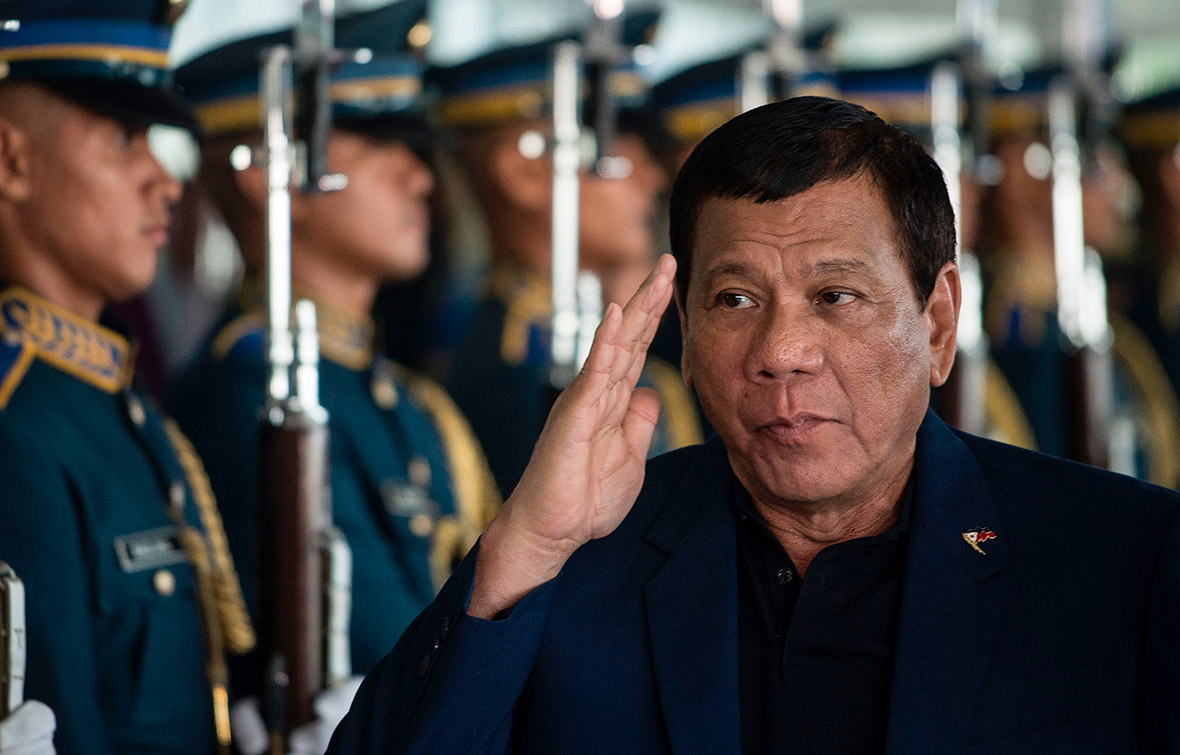
Philippines President Rodrigo Duterte is never short of politically
controversial statements. His latest was addressed to Filipino troops
engaged in implementing martial law in the restive Mindanao region.
While
reassuring them that they have his full backing, Duterte told the
troops he is ready to bear the consequences of fighting the extremists.
Then the foul-mouthed president went on to jokingly remark: "You can
each rape three women and I will protect you." He also told the troops
that they were free to arrest any person or search any house if
necessary.
On 24 May, Duterte declared martial law in southern Philippines
after intense clashes broke out between the Filipino military and the
Maute group, an extremist organisation that pledged allegiance to the
Isis. He had to abruptly cut short his trip to Russia and return to
control the escalating situation.
The whole of the southern region of Mindanao is under martial law, bringing roughly one-third of the country or up to 20 million people under the emergency measure.
"Do
not worry. I will join you. I will... If you go down, I go down. But
for this martial law and the consequences and [its] ramifications, I and
I alone would be responsible. I am here to say to you, fight and I will
pray for you and I will answer for everything," Duterte told his
military personnel.
Minute's silence in Manchester ends with emotional rendition of Don't Look Back in Anger@PaulKeaveny
The
suspect in the deadly Manchester concert bombing was driven by what he
saw as unjust treatment of Arabs in Britain, a relative said Thursday,
confirming he made a final phone call in which he pleaded: "Forgive me."
Salman
Abedi was particularly upset by the killing last year of a Muslim
friend whose death he believed went unnoticed by "infidels" in the UK,
said the relative, speaking on condition of anonymity over concerns for
her own security.
"Why was there no outrage for the killing of an
Arab and a Muslim in such a cruel way?" she asked. "Rage was the main
reason," for the blast that killed 22 at the end of an Ariana Grande concert at Manchester Arena on Monday, she said, speaking by telephone from Libya.
The new insight into Abedi's motivation came as Britons faced stepped-up security,
authorities pushed forward with raids and the investigation extended
across Europe into Libya, where most of the suspected bomber's family
lived.
The number of arrests in the UK ticked up to nine
as British Transport Police said armed officers would begin patrols on
some trains because of an increased threat of terrorism. Greater
Manchester Police Chief Constable Ian Hopkins said, without elaborating,
that searches of suspects' homes brought "very important" clues in the
probe of the bombing. But leaks from the investigation were creating a
trans-Atlantic diplomatic mess.
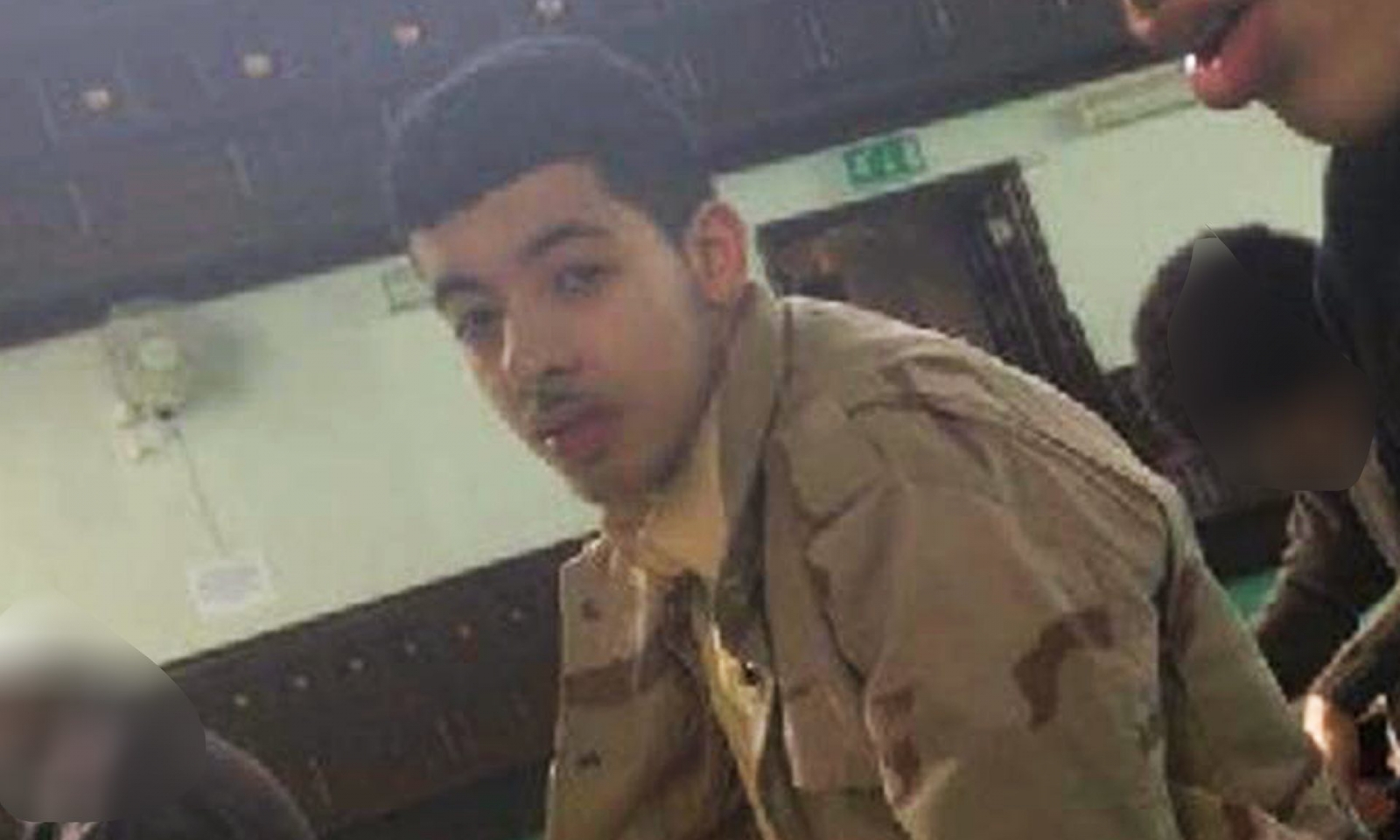
Manchester police halted their sharing of investigative information with the US through most of Thursday until receiving fresh assurance there would be an end to leaks to the media. Manchester suicide bomber Salman Abedi is seen in a photo taken several years agoHandoutBritish
Prime Minister Theresa May, who spoke about the matter with US
President Donald Trump at a Nato summit in Brussels, said the countries'
partnership on defense and security was built on trust. But "part of
that trust is knowing that intelligence can be shared confidently," she
said.
Trump pledged to "get to the bottom" of the leaks, calling
them "deeply troubling" and asking the Justice Department and other
agencies to "launch a complete review of this matter."
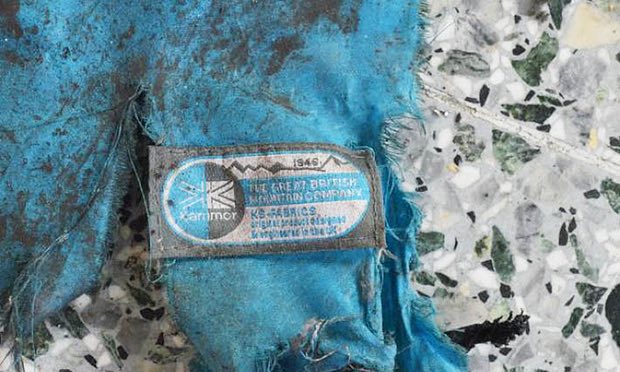
British officials were particularly angry over photos published by The New York Times showing remnants of a blue backpack
which may have held the explosive. But it wasn't clear US officials
were the source of the images, which the Times defended as "neither
graphic nor disrespectful of victims" and consistent with basic
reporting "on weapons used in horrific crimes."
British security services were also upset that 22-year-old Abedi's name was apparently leaked by US officials
while police in the UK continued withholding it and while raids were
underway in Manchester and in Libya. Hopkins said the leaks "caused much
distress for families that are already suffering terribly with their
loss." One of the photographs of the Manchester bombing leaked shows part of a rucksackNew York TimesMeanwhile, the investigation into the blast widened.
Authorities
chased possible links between Abedi and militants in Manchester,
elsewhere in Europe, and in North Africa and the Middle East. They were
exploring potential ties to Abdalraouf Abdallah, a Libyan jailed in the
U.K. for terror offenses, and to Raphael Hostey, an Islamic State
recruiter killed in Syria.
Abedi's
family remained a focus, too, with a brother in England, his father and
another brother in Libya among those detained. Abedi's father was
allegedly a member of the al-Qaida-backed Libyan Islamic Fighting group
in the 1990s — a claim he denies.
An emerging portrait of the
bomber remained complicated by competing assessments over whether Abedi
held views that had sparked concern before the bombing.
Akram Ramadan, a member of the Libyan community in Manchester who attends the city's Didsbury Mosque, said Abedi was banned from the mosque after he allegedly interrupted an imam's anti-Islamic State sermon.
"He
stood up and started calling the imam — 'You are talking bollocks,'"
Ramadan said. "And he gave a good stare, a threatening stare into the
imam's eyes."
Mohammed Fadl, a community leader, rejected that
account. While Abedi's family was well-known in Manchester, Abedi
himself did not attend many gatherings, Fadl said.
However, Fadl
said he had heard Abedi's father took his son's passport away over
concerns about his ties to alleged extremists and criminals.
"Very
few people in the community here were close to him, and therefore
Salman's fanaticism wasn't something the community was aware of," he
said.
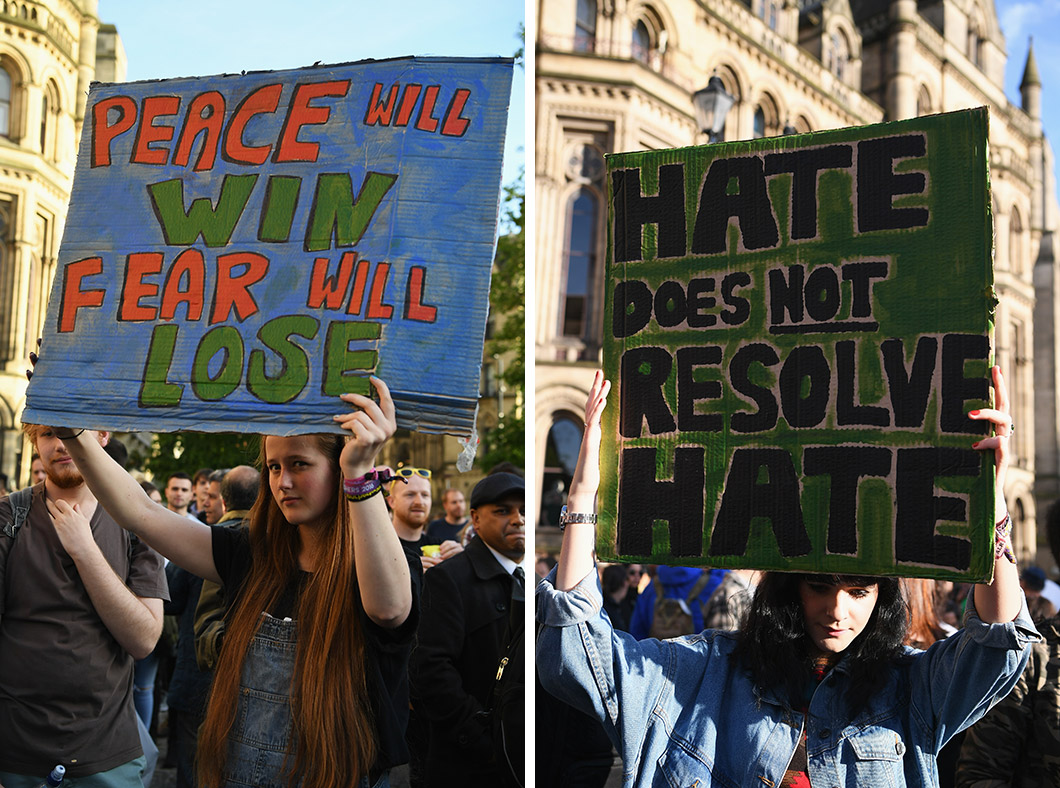
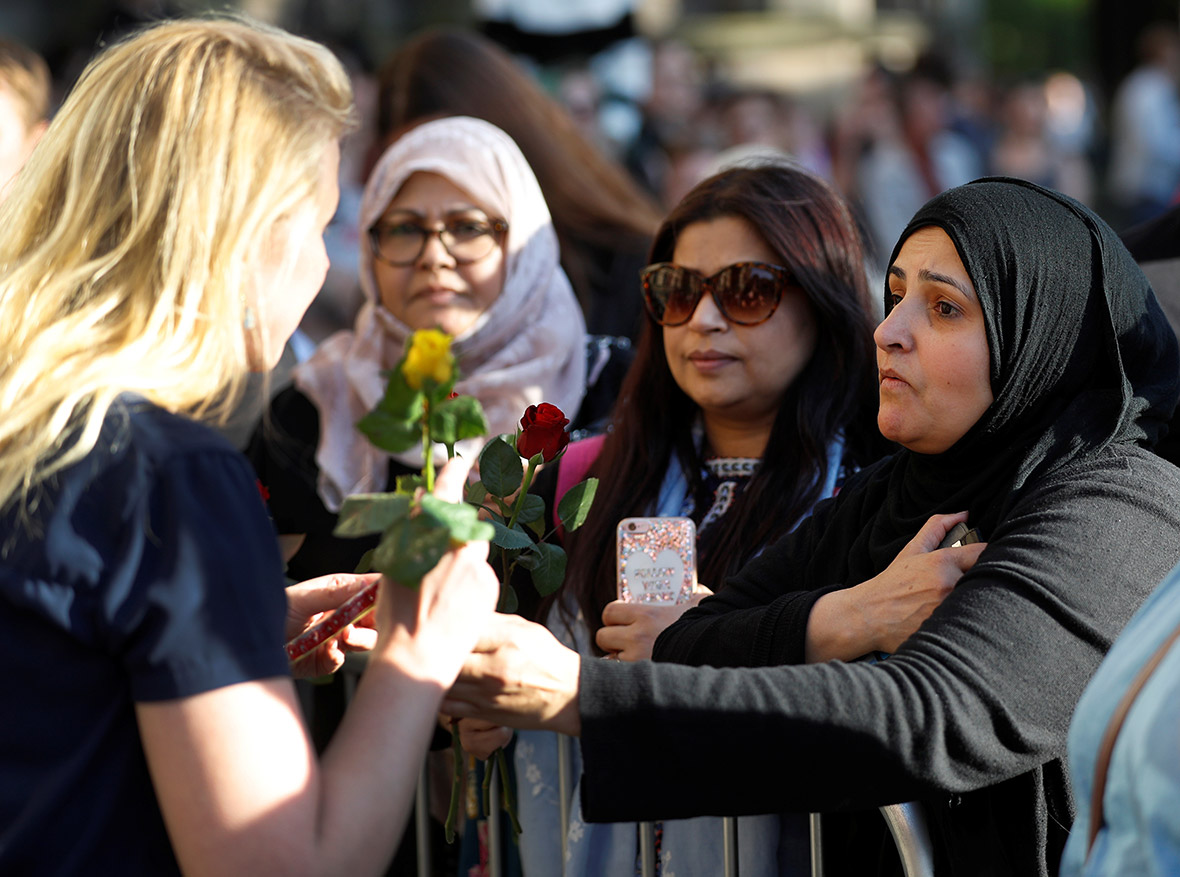
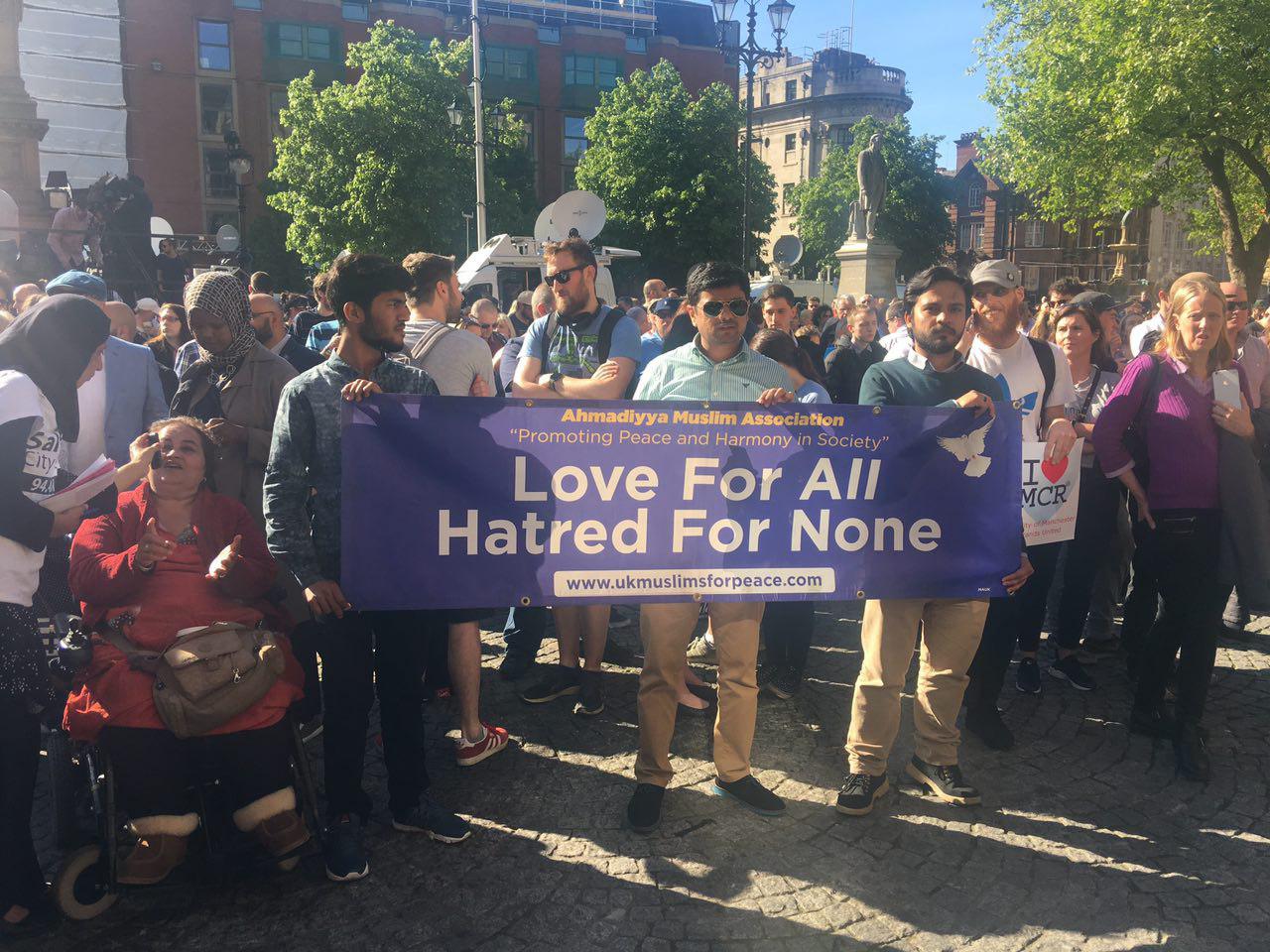
People of all faiths take part in a vigil in Manchester for the victims of the attackAhmed
bin Salem, a spokesman for the Special Deterrent Force in Libya, said
Abedi placed his final call to both his mother and a brother. Abedi's
relative said he had spoken with his brother only, asking that his
message be relayed to his mother.
"He was giving farewell," bin Salem said.
Abedi's
relative said the suspected bomber was pained by the killing of
Abdel-Wahab Hafidah, an 18-year-old who news reports say was chased by a
group of men, run over and stabbed in the neck in Manchester in May
2016.
"They wouldn't let you share bread with them," she said Abedi told her. "They are unjust to the Arabs."
Bin
Salem said Abedi's mother told investigators her son left for the U.K.
four days before the attack after spending a month in Libya. Based on
the account from a younger brother, investigators think Abedi used the
internet to learn how to make a bomb and "seek victory for the Islamic
State," bin Salem said.
The allegations clashed with what Abedi's
father said a day earlier in an interview with the AP. "We don't believe
in killing innocents," Ramadan Abedi said before he was detained in
Tripoli.
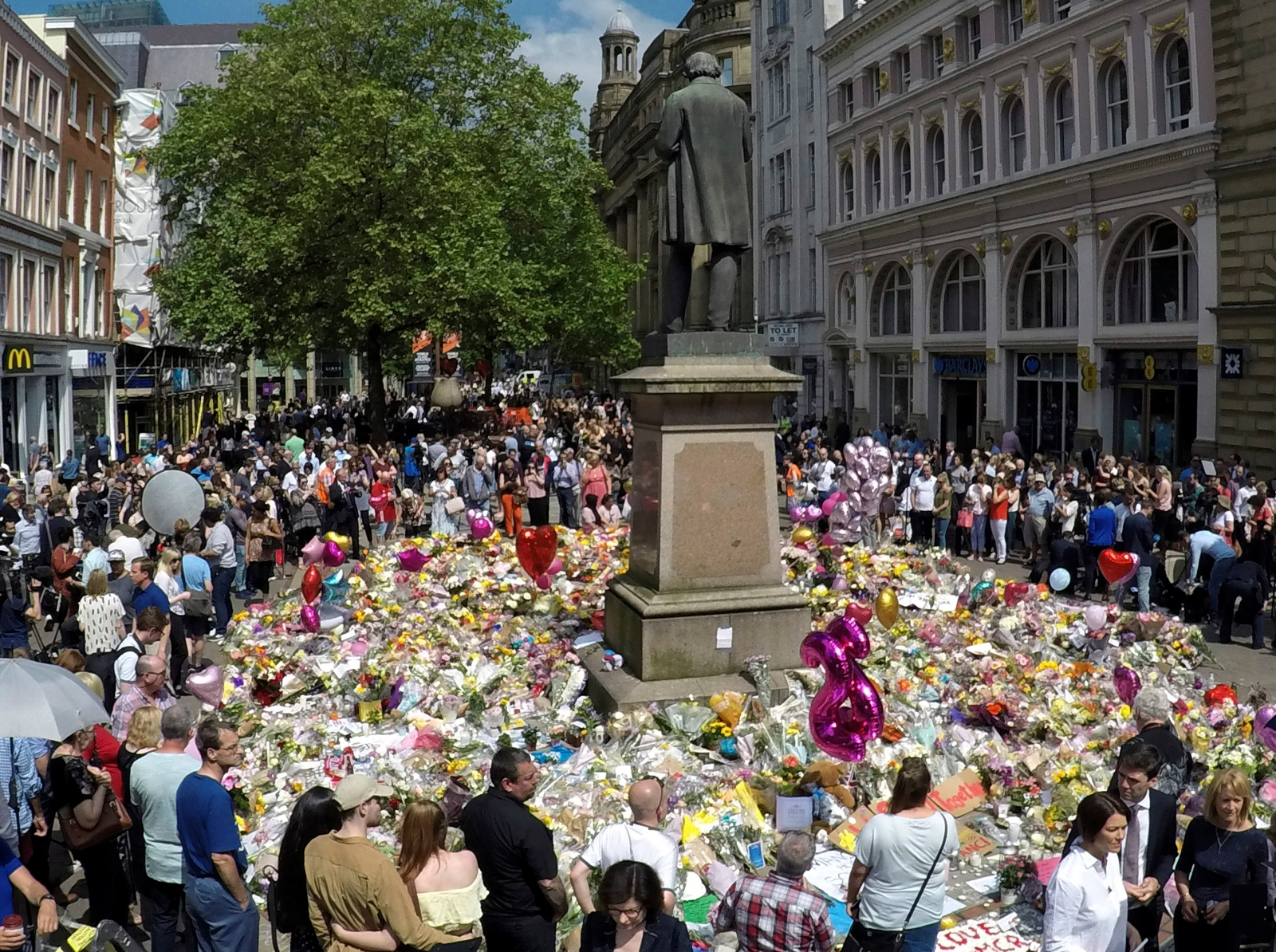
Balloons, flowers and messages of condolence are left for the victims of the Manchester Arena attackAround the UK, many fell silent Thursday for a late-morning minute in tribute to the victims.
In
Manchester's St. Ann's Square, where a sea of floral tributes grew by
the hour, a crowd sang the hometown band Oasis' song "Don't Look Back in
Anger." Queen Elizabeth II visited victims of the attack at Royal
Manchester Children's Hospital, telling 14-year-old Evie Mills and her
parents: "It's dreadful. Very wicked, to target that sort of thing."
Fifteen-year-old
Millie Robson, wearing one of Grande's T-shirts, told the queen she had
won VIP tickets to the pop star's concert. She recalled leaving the
concert when the blast struck and remembered an intense ringing in her
ears, but not being entirely aware that she was bleeding badly from her
legs.
The teenager credited her father's quick action in picking her up and tying off her wounds to stem the bleeding.
"Compared to other people I'm quite lucky really," she said.
In
addition to those killed, 116 people received medical treatment at
Manchester hospitals for wounds from the blast. The National Health
Service said 75 people were hospitalized.
Abdul Malik Badreddin al-Houthi, the leader of Yemen’s Houthi Ansarullah movement
The leader of Yemen’s
Houthi Ansarullah movement says Saudi Arabia seeks to split the Muslim
Ummah — the Muslim people as a whole — and to turn them into indecisive
people who can be exploited.
Abdul Malik Badreddin
al-Houthi made the remarks in a Saturday message to the Yemeni public,
in which he also felicitated them on the occasion of the start of the
Muslim fasting month of Ramadan, Yemen’s al-Ahd news agency reported.
He
said Saudi Arabia was the leading regime among the “regional
hypocrites, which only seek destruction and sedition to execute American
and Zionist plots.”
The recent visit to Saudi Arabia by United
States President Donald Trump — during which Washington agreed to sell
Riyadh 110 billion dollars worth of arms — was likewise to the benefit
of the Israeli regime, Houthi said. A
handout picture provided on May 22, 2017 shows US President Donald
Trump waving as he boards Air Force One before leaving Riyadh. (Via AFP)Houthi
urged Yemenis to strengthen their faith in order to confront the
challenges facing them, especially the plots of the “Saudi-American
invaders.”
Saudi Arabia has been waging war on Yemen since 2015 to
restore a former president who was friendly to Riyadh. The invasion, in
which the US also provides assistance to Saudi Arabia, has killed
thousands of civilians.
The Houthi leader urged the mercenaries
fighting on behalf of Saudi Arabia to mend their ways. He invited them
to exchange all the hostages they were holding with the prisoners held
by the Houthis during Ramadan.
Every week, IRIN’s team of editors looks ahead at what’s on our
humanitarian radar and curates a selection of the best reports, opinion,
and journalism you may have missed: What will martial law mean for the Philippines?
The Philippines’ tough talking president, Rodrigo Duterte, has
declared martial law in the southern Island of Mindanao, and he’s
threatened to extend it throughout the entire country. Duterte made the
declaration as fighting raged in the city of Marawi between security
forces and a group of Islamist militants who have pledged allegiance to
the so-called Islamic State. Islamist militancy has been gaining
strength as a peace process wavers in Mindanao, as we reported
just over a year ago. The warnings came quickly. Many asked why Duterte
had enforced martial law in all of Mindanao rather than confining it to
the area where fighting was taking place. Others heard echoes of
Ferdinand Marcos, who ruled as a brutal dictator from 1972 to 1981 after
declaring martial law – especially since Duterte promised that his
version would “not be any different from what the president, Marcos,
did. I'd be harsh.” Duterte’s words were particularly chilling in the
wake of the about 7,000 people killed since he declared a war against
drugs almost a year ago. Under the constitution, martial law can be
imposed for 60 days. The coming days and weeks may give an indication of
whether Duterte plans to extend or expand it, and whether there is a
danger that the Philippines could slip back into autocracy. Don’t do it, Donald
US President Donald Trump looks set to wage a more aggressive military campaign in Somalia. The New York Times
provides cogent reasons why he shouldn’t. More strikes do nothing to
address Somalia’s root issue of state weakness and poor governance.
“Instead, they may create more problems by allowing African Union forces
to retreat, further militarize American policy, sideline diplomatic
engagement and undercut the newly elected Somali president,” the paper
says.
By declaring parts of Somalia an “area of active hostilities,” Trump
is removing an Obama-era vetting process, which “potentially lowers the
bar for tolerance of civilian casualties”. Dead innocents are a powerful
recruitment tool for al-Shabab, and a vote-loser for the popular new
government. If humanitarian and development aid can survive Trump’s
budget axe, that would seem a better investment than doubling-down on a
dubious military adventure.
Meanwhile, this timely study
explores the African Union’s attempts to protect civilians during its
peace operations – Somalia included. It notes that most AU operations
are military-heavy, despite the fact that protecting civilians requires
“a combination of policing, civilian and military expertise”. Military
intervention is an instrument, not a strategy. Stability and sustainable
peace entail a political process. “In sum, the AU should put more
emphasis on developing its political muscle to end armed conflicts and
crises, as well as flexing its military muscle,” the study notes. WHS one year on
After a long build up, the World Humanitarian Summit
concluded in Istanbul exactly one year ago with more than 3,000
commitments from the world’s largest donors and aid agencies to reform
the aid system. Twelve months on seems like a good time to reflect on
what the summit achieved and what progress has been made on that
bewildering array of pledges. This week UN Secretary-General Antonio
Guterres released a brief statement alluding to the anniversary and the Agenda for Humanity
in which his predecessor, Ban Ki-Moon, set out a framework for
humanitarian reform ahead of the WHS. Guterres applauded “progress that
is being made by so many stakeholders to take forward the commitments
they made in Istanbul”. Christina Bennett of the Overseas Development
Institute takes a more critical view,
noting that while the WHS sparked some much needed “self-reflection in
the aid sector” and “revived and modernised some rusty yet vital
debates”, its landmark agreement on reforms to aid financing – the Grand
Bargain – “has been slow in inspiring real change”. Our recent report on progress towards the Grand Bargain reached a similar conclusion. The commitments on “localisation”
have been particularly troublesome. Bennett notes that “it took nine
months to agree on who ‘local responders’ are and what ‘funding them as
directly as possible’ means.” Going forward, Bennett recommends a dose
of political pragmatism and the need to identify an influential
individual to lead and champion the Grand Bargain’s implementation.
One of the major outcomes from the WHS was a commitment by the
humanitarian and development sectors to work together more closely and
to partner with local and national actors towards long-term
capacity-strengthening. The so-called “New Way of Working” (the aid
sector loves a catch phrase!) has dominated recent discussions at aid
policy conferences, including an anniversary WHS meeting in Istanbul last week. Next week, we’ll be delving more deeply into how transformative the New Way of Working really is. Who cares?
Across the world, citizens are growing less supportive of
humanitarian action and less confident that as individuals they can make
a positive difference to the global refugee crisis. These are the key
points of today's 2017 Aurora Humanitarian Index,
which is based on a survey of 6,500 people in 12 countries on their
attitudes to global humanitarian issues, the effectiveness of response,
and personal motivations to intervene. The index includes a ranking of
pressing humanitarian concerns: 63 percent of respondents put terrorism
at the top of their list of worries. The next most frequently expressed
top concerns are the widening gap between the rich and poor, hunger,
climate change and forced migration. Just nine percent of those surveyed
said they thought their actions could help solve humanitarian issues.
On a more positive note, the survey found that younger people bucked
the trend, as a much higher proportion of them showed “positive
attitudes to humanitarianism and the individual impact on the refugee
crisis.”
Some other key findings:
42 percent of respondents feel their countries have already taken in too many refugees.
34 percent of respondents agree that immigrants make their country a
better place to live, yet one-third view migrants as a threat to their
religious beliefs.
44 percent of respondents feel their country is threatened by ethnic
minorities. This figure rises significantly in the UK (56 percent);
Kenya (56 percent); Turkey (55 percent); and France (54 percent).
Younger respondents value diversity, with 29 percent agreeing it is
better for a country if everyone shared customs and traditions.
The Index will be presented on Sunday in Yerevan, during the
Aurora Dialogues, a platform for the world’s leading humanitarians,
academics, philanthropists, business leaders and civil society to bring
awareness to today’s most pressing humanitarian challenges. Did you miss it? Who is to blame for the murders of Michael and Zaida?
The Democratic Republic of Congo is opposing
an international investigation into the deaths of two UN investigators,
Michael Sharp and Zaida Catalan. That’s disappointing because it’s
exactly what is needed. In a useful examination of the current
finger-pointing, the Congo Crisis Group takes issue
with a recent New York Times report highlighting the “complicity” of
the UN in the killings, and the insinuated involvement of an opposition
politician. It argues that could play into the government’s hands, given
the potential video evidence
of a government role. The CRG is also scathing about the UN’s board of
inquiry, which seems more concerned with understanding whether UN rules
and regulations were followed than identifying the perpetrators of this
crime, and more widely the thousands of other civilian deaths in Kasai.
(TOP PHOTO: Rebels guard a base in Mindanao, June 2015. Jason Gutierrez/IRIN)
jf-oa-ks-am
ARKLATEX-- - "Slavery today is at its highest that its
ever been in history," says LeAnn Bussey, Purchased Not For Sale
Director.
An alarming fact since most think slavery ended in 1863, when President Abraham Lincoln issued the emancipation proclamation.
"It
just flies so under the radar that it's hard to catch. I think that's
why people assume that slavery isn't happening today because it's not
out in the open and seen like it was 100 years ago and back in the day,"
says Bussey.
Human trafficking is nothing new to the Arklatex, with Interstate-20 and casinos being a driving force.
This sex slavery brings in more money per year than the NBA, NFL, and the MLB combined.
"Just
think about football alone and the fans, and everything that it brings
in, and human trafficking brings in triple that," says Bussey.
And there's no stereotype.
It does not know color, education, gender, or age, with the average age of entry into sex trafficking being 11-years-old.
"That means there are children under 11 that are being forced into sex slavery," says Bussey.
"The
youngest child I have spoken to was 8-years-old and her caregiver had
trafficked her for rent money," says Alex Person, Forensic Interviewer
Gingerbread House.
With these unfortunate statistics, there are warning signs you need to know that could help save a life.
"Such
as itching in the private part area, having issues using the bathroom,
they may be potty trained and now they are having accidents on
themselves, just behavior change in general," says Person.
Knowing the warning signs starts with education.
"We
educate children on body safety, what to do if someone touches your
body, what parts of your body no one is supposed to touch, and secrets
that we don't keep and how we always tell," says Person.
"We
educate parents on signs to look for if a child is being abused. We
educate parents on what to do if a child has disclosed abuse. We educate
schools and medical offices on mandated reporting," says Person.
Sex slavery is a huge problem, but has a huge answer, with numerous partners in the area lending a helping hand.
"Every
woman and child that walks through our door is a success story. It
takes a lot of courage to leave the only thing you've ever known even if
the only thing you've ever known is chaos and pain," says Bussey.
'Purchased Not For Sale' offers free GED programs through a partnership with Bossier Parish Community College.
"They don't charge us for that. They send over a teacher free of charge for us and our ladies," says Bussey.
And job readiness skills.
"Of
course the employer is going to ask what have you been doing for the
past 10 years, and that's a hard question to answer when you have to say
I've been in a strip club, or prostituting, or trafficked, we help them
kind of fill in those gaps and how to answer those questions," says
Bussey.
While the 'Gingerbread House' helps children realize they are victims.
"Most
of the children that come in were not sure they were being trafficked
until we get in the forensic interview and we start talking to them and
then we realize red flags and signs," says Person.
And get them out before its too late.
"We see parents or caregivers who have trafficked their children for rent money, drug money, alcohol," says Person.
Unfortunately the number of success stories is outnumbered by those that don't make it out alive from human trafficking.
With the detection of warning signs, we can all help bring men and women out of slavery.
"They are created for a better life than what they've been through," says Bussey.
The
just-concluded London Somalia Conference 2017 hosted by the United
Kingdom brought to the fore the grim reality of the humanitarian
catastrophe plaguing Somalia. After the collapse of
the country’s central government led by Mohammed Siad Barre in 1991, the
Somali people have never known peace. Most of the infrastructure, the
economy and all legitimate institutions have been destroyed, making
Somalia one of the poorest countries in the world. More than 43 per cent
of its population of over 12.3 million lives in extreme poverty.
Somali’s Gross Domestic Product per capita of $284 is the fifth lowest
in the world. The conference, meant
to accelerate progress on security reforms being undertaken in Somalia
as well as create global awareness of the ongoing drought and
humanitarian crisis, brought together heads of state and government from
across East Africa and other key partners from international
organisations.
It is saddening that
4.7 million Somalis depend on humanitarian aid. More than 300,000
children under the age of five years are acutely malnourished, with 1.7
million out of school. The situation was made
worse by the devastating famine of 2011, which claimed the lives of
258,000 people – a half of them children under the age of five years.
More than 1.1 million people are internally displaced, mostly due to
insecurity and drought. There are more than one million Somali refugees
in neighbouring countries. It is unfortunate that
continued efforts by the Somalis and international supporters to bring
peace have been frustrated by frequent attacks by the al-Shabaab
extremist group, corruption, and regional and clan disputes. Efforts by
the weak Somali government in Mogadishu to stabilise the country and
hold elections have been consistently frustrated. Indeed, Somalia is
chronically unstable, with a large part of the country under the control
of the al Shabab militia. In 2011 alone, piracy along the Indian Ocean
cost the global trade $7 billion. In the same year, famine cost the
lives of 250,000 Somalis. Currently, more than half of the Somali
population are without a reliable source of food as drought and famine
ravage the country. It is these grim
realities that brought the international community to the first London
Somalia Conference in 2012 to help build a peaceful and prosperous
Somalia.
It is commendable that
out of the London Somalia Conference, a transitional federal government
was established in 2012 and the roadmap to a federal government has
begun to take shape. The African Union Mission to Somalia (AMISOM),
which forms part of the peacekeeping mission forces has managed to push
al Shabab out of key cities. A number of Islamic extremist groups that
had travelled to Somalia have also began to fall. The number of sea
attacks has considerably decreased, thanks to international naval forces
and an increased focus on addressing the drivers of piracy. A
development agreement between Somalia and the international community
has enabled the delivery of humanitarian aid to millions of the most
vulnerable persons in Somalia. But even as we
celebrate the milestones made, we must acknowledge that more efforts are
needed to prevent the country from returning to open conflict and to
ensure political and economic development. It is crucial for
Somalia and its partners to work on improving security by ensuring the
Somali National Army is empowered to enable it to counter terrorism and
to protect human rights. To help build a more
inclusive, federal and democratic state, Somalia and its international
partners must commit to political reforms and governance. Leaders of the
East African Community have a key role to play in helping Somalia to
conduct constitutional reforms. The EAC has a duty to
support Somalia’s economic recovery, enabling it to build a vibrant
economy that creates jobs and generates domestic revenue. To achieve
these aims, international donors and Somalia’s private sector must work
together to deliver a workable economic recovery roadmap for the coming
years. Both regional powers
and the international community must commit themselves to prevent
widespread famine in Somalia, ensuring we continue building on the
milestones achieved since 2012. As the London Somalia
conference works on a New Partnership for Somalia (NPS) between the
international community and the country, EAC leaders must be proactive
in ensuring the new partnership holds. The NPS seeks to work together to
meet Somalia’s most pressing political, security and economic needs and
aspirations. Somalia’s transition
to a more peaceful and prosperous country by 2020 is for the common good
of the Somali people and the region as a whole. Supporting refugee host
countries in the region is also key to ensuring regional commitment to
the peace process.