Islam is the real positive change that you need to change for being a better person or a perfect human being, you can change yourself if you read QURAN, IF YOU DO THAT !! you will change this UMMAH, say I am not A Sunni or Shia, BUT I am just a MUSLIM. Be a walking QURAN among human-being AND GUIDE THEM TO THE RIGHT PATH.
Pages
▼
Thursday, November 17, 2016
‘It will blow up’: fears Myanmar's deadly crackdown on Muslims will spiral out of control
Generations of distrust between Rohingya Muslims and wider Buddhist
population have boiled over into reprisals fuelling the spectre of an
insurgency
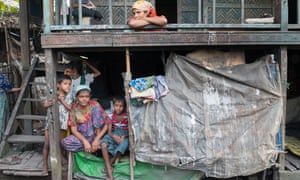
A Rohingya family in Aung Mingalar ghetto, Rakhine state, Myanmar.
Photograph: Aung Naing Soe for the Guardian
Poppy McPherson in Sittwe
Kyaw Hla Aung’s voice trembles as he speaks.
“The situation is really bad here,” he says, sitting in a bamboo hut
inside an internment camp on the outskirts of Sittwe, capital of
Myanmar’s troubled Rakhine state.
The 77-year-old Rohingya Muslim community leader, a former lawyer,
was jailed numerous times for political activities under Myanmar’s
former military governments. He is used to scrutiny. But, this time, he
says it is different.
“The military came and they are warning everybody not to keep any strangers,” he says.
Rohingya in the camps, where tens of thousands have been confined
since communal violence in 2012, have stopped gathering in groups to
avoid attracting suspicion. In at least one village they were ordered by
the army to demolish fences surrounding their homes.
There is good reason to be afraid. A few dozen miles north, in
northern Rakhine’s Maungdaw township, a conflict is raging between the
military and the Rohingya population. A series of deadly attacks on security forces by a group apparently supported by members of the diaspora has raised the spectre of a new insurgency. It has also prompted a severe crackdown.
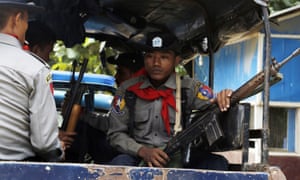
The army has framed the fighting, which broke out on 9 October after
nine police and five soldiers were killed at three border posts, as an
“invasion” and announced plans to train and arm Buddhist civilians to protect their villages.
Ensuing security sweeps have killed dozens of alleged attackers. Last
weekend, more than 30 died after soldiers fired from helicopters on a
mob of men they say were armed with guns, knives and spears.
But human rights groups say scores of Rohingya civilians may be among
the casualties. Images and video circulated on social media appear to
show the bodies of men, women and children with gunshot wounds, while
satellite images published by Human Rights Watch show villages razed to
the ground. Rohingya women in several areas have accused soldiers of
rape.
The army denies this. The authorities consider Rohingya to be illegal
immigrants from Bangladesh, although many trace their heritage in
Myanmar for generations. State media says they fabricated the rape
allegations and burned down their own homes. And because the area is
off-limits to foreign journalists, it has been very difficult to verify the competing claims.
Rohingya in Sittwe say they know nothing about any militant group.
Many believe the episode is a creation of the army, which still wields
tremendous power despite a handover to civilian government led by Aung San Suu Kyi earlier this year. But some warn that oppression of the minority is heading towards breaking point.
A recent report by Physicians for Human Rights documented how
restrictions on movement, land confiscation, pervasive surveillance and
extortion in northern Rakhine since the 2012 clashes had left some
120,000 displaced.
“Now, it’s been four years with people in these conditions and
suffering; many young people spending their teenage, adult years with
nothing to do,” says Kyaw Hla Aung.
Asked whether he thinks there is an insurgency, he says: “No, no, but
they are suffering and suffering and suffering, so they cannot bear, so
it will blow up.”
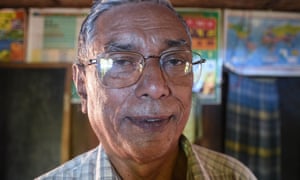
U Kyaw Hla Aung, a Rohingya leader from Sittwe, capital of Myanmar’s
troubled Rakhine state. Photograph: Aung Naing Soe for the Guardian
In a statement published a few days after October’s attacks, the
government blamed a previously unknown armed group of “extremists”,
Aqa-Mul-Mujahidin, whose leader, named as Haviz Tohar, allegedly trained
with the Pakistani Taliban. Aung San Suu Kyi later appeared to walk
back on some of those claims, saying they were based on information that
may not be credible.
Meanwhile, videos posted online by a group calling itself the Faith
Movement show a contingent of young men, and some boys, armed with
swords and some guns, claiming to be Rohingya freedom fighters.
According to analysts from the Terrorism Research and Analysis
Consortium (Trac), at least seven videos were posted between 10 and 27
October. None mention Aqa-Mul-Mujahidin or Haviz Tohar. Instead, some
introduce a “chief” named as Abu Ammar Junooni, a bearded man sitting in
the centre of a small band of men.
“Each video calls for an armed struggle,” says Veryan Khan, editorial
director at Trac, while three “specifically call for a jihad”.
Some of the clips give a list of demands, including the restoration
of Rohingya ethnic rights, and stress their “self-defence” is focused on
the military. An English-language “press statement” says the group is
“free from all elements of terror but seeks fundamental rights for all
Arakanese [Rakhine]”.
Tin Maung Shwe, a senior Rakhine state official, says security had
been boosted across the country. “This is a murder case,” he says. “We
will take action against everyone who committed this. If they are living
in Myanmar, they have to follow Myanmar’s constitution, whatever their race is.”
Rohingya women living in a camp for internally displaced people in Myanmar. Photograph: Aung Naing Soe for the Guardian
Militancy in Rakhine state is not a recent phenomenon. Muslim
movements demanding an autonomous region in northern Rakhine cropped up
throughout the latter half of the 20th century. These included the
Rohingya Solidarity Organisation (RSO), thought to have been defunct
since the 2000s.
A transcript of an audio recording obtained by a source familiar with
the Rohingya diaspora and shared with the Guardian features a man
saying the people involved are “not only RSO”.
The man, believed to be an ethnic Rohingya living abroad, describes the 9 October attacks as a “big success”.
“These are our people and the system of the people is working well,”
he says, stressing that “help” can be sent through an underground
network of individuals.
“They [Myanmar military] looked down on us, ignored us and kept
silence by saying that our kalars [a derogatory term for Muslims] do not
have anything. Insha Allah, we succeeded.”
Speaking a few days after the release of the government statement,
Ehsan Ullah Batth, Pakistan’s ambassador to Myanmar, said he had
received no “actionable information” about Pakistani involvement.
Of an alleged accomplice the government named Kalis, purportedly Pakistani, he said: “I don’t find any such name in Pakistan.”
While connections to international organisations may be uncovered,
the demands of the videos are locally focused: liberation of Rohingya
from the camps, restoration of citizenship and property.
Richard Horsey, a Yangon-based political analyst, says: “I think what
is important to stress is that so far the modus operandi of the
attackers has been similar to the old RSO and other insurgent groups,
not terrorism – that is, attacks have been on security targets, not
civilians or religious sites.”
Matthew Smith, founder and chief executive of non-profit Fortify
Rights, agrees. “The militants don’t appear to be well-organised or
well-armed, and they’re tiny compared to dozens of other armed groups or
militias in the country,” he says.
“If this [Rohingya militancy] is a strategy to negotiate with the
army, and to have a seat at the table alongside other ethnic armies in
the peace process, it’s profoundly ill-conceived.
“We fear the military will unleash an unprecedented wrath on northern
Rakhine state, and that won’t bode well for Rohingya rights.”
In the displacement camp outside Sittwe, Kyaw Hla Aung says Rohingya
leaders were recently called to a meeting with the military. “We
submitted to them that, in Sittwe, our people didn’t involve in this
case.”
Past the army base and razor-wire fences that divide the camps from
Rakhine Buddhist neighbourhoods, the Muslim ghetto in downtown Sittwe is
racked with fear.
“We are doing security for the quarter by ourselves,” says one
Rohingya leader during a few snatched moments of conversation out of
sight of a plainclothes police officer.
“We are not sleeping at night, we sleep in the morning, wake up in
the evening. After the Maungdaw attacks, we are afraid someone will take
revenge.” Additional reporting by Aung Naing Soe.
Anna Fifield (@annafifield)
New satellite imagery shows how Burma's military is torching villages https://t.co/1Kx5i1iTGR pic.twitter.com/yWhd5zTon7November 15, 2016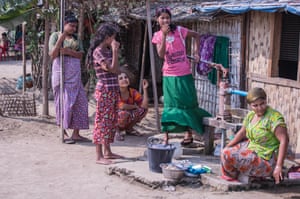
No comments:
Post a Comment