Thursday, December 1, 2011

US must stop jailing minors for life, says Amnesty

Generic prison picture Amnesty says severe sentences for young offenders often do not take account of mitigating factors
Amnesty International has called for the US to stop sentencing juveniles to life in prison without parole.
More than 2,500 adults are in US jails for crimes committed as a child - under current rules they will never be freed.
In its new report, Amnesty says the practice is incompatible with the basic principles of juvenile justice.
The US and Somalia are the only two countries not to have ratified a UN convention that bans life in jail without parole for under-18 year olds.
'Potential for rehabilitation' Amnesty says offenders as young as 11 have faced such sentences in the US.
"In the USA, people under 18 years old cannot vote, buy alcohol, lottery tickets or consent to most forms of medical treatment," said Natacha Mension, of the human rights group.

AMNESTY CASE STUDY

Christi Cheramie was jailed for life without parole in 1994 in Louisiana when she was 16 years old. She was convicted of second-degree murder in the killing of her 18-year-old fiance's great aunt. Cheramie says he did it.
She says she pleaded guilty just before her trial in an adult court began to avert a potential death sentence. A psychiatrist who saw Cheramie before trial said she seemed "fearful of crossing" her fiance. Her childhood was marked by sexual abuse. At age 13, she was admitted to a psychiatric clinic after suicide attempts.
In 2001, Cheramie tried to withdraw her guilty plea, but the request was denied. Now 33, she has a high-school equivalency diploma and a degree in agricultural studies. A warden says Cheramie is "worthy of a second chance". She is applying to the state prison board for executive clemency.
"But they can be sentenced to die in prison for their actions. This needs to change."
More than half of US states have approved the use of mandatory life sentences without parole for some serious crimes, such as murder.
The US Supreme Court has already acted on some aspects of youth sentencing - and a review is underway.
In May last year it banned sentences of life without parole for minors in non-murder cases.
Earlier this month, it agreed to consider the issue in relation to homicide cases, too; a decision is not expected until next year.
Amnesty's report, This is where I'm going to be when I die, says such sentences are handed down without considering factors such as history of abuse or mental health.
"We are not excusing crimes committed by children or minimizing their consequences, but the simple reality is that these sentences ignore the special potential for rehabilitation and change that young offenders have," said Ms Mension.
Amnesty wants the US to ratify the UN Convention on the Rights of the Child, which has been in force for two decades.
It prohibits the imposition of life imprisonment without the possibility of release for any offence committed by under-18-year-olds.



Al-Shabaab bans aid agencies in Somalia and raids offices


Islamic group permanently revokes permission for organisations including Unicef and WHO to work in country amid famine crisis
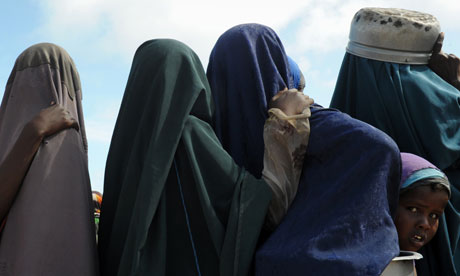
A Somali girl joins queue for a hot meal at a camp
A Somali girl joins women queuing for a hot meal at a camp. Al-Shabaab has banned several aid agencies. Photograph: Roberto Schmidt/AFP/Getty Images
Efforts to feed 160,000 severely malnourished children in Somalia have been jeopardised after Islamist rebels banned several UN and international aid agencies, storming their offices in a string of co-ordinated raids.
Al-Shabaab militants, who have imposed a harsh form of sharia law in south and central Somalia, announced on Monday they were banning 16 aid agencies from operating in the anarchic country where tens of thousands of people have died from famine since April.
The United Nations Children's Fund (Unicef) said its office in the southern city of Baidoa had been occupied, but that all staff were safe.
Jaya Murthy, interim communications chief for Unicef Somalia, said al-Shabaab's actions could threaten feeding programmes for 160,000 severely malnourished children across the centre and south of the country.
"We are extremely concerned that any interruption to our assistance could result in the death of thousands of children … If our supply pipelines are disrupted, it spells the imminent death of those children," he said.
Somalia, which has had no stable government for two decades, has plunged even deeper into misery this year because of a severe drought and an intensification of fighting as first Kenyan and then Ethiopian forces crossed the border in the past few weeks to tackle the al-Qaida-linked Islamist rebels.
Al-Shabaab, which is fiercely opposed to any western or regional intervention, banned food aid last year in the areas it controls and kicked many relief organisations out, saying aid created dependency. It lifted the ban in July but now appears to have reneged on that.
In a statement, the group said it had "decided to permanently revoke the permissions" of the listed aid agencies to operate inside Somalia, accusing them of being "subversive groups" and "persistently galvanising the local population against the full establishment of the Islamic sharia system".
The list includes the UN high commissioner for refugees (UNHCR), Unicef, the World Health Organisation (WHO), Concern and the Norwegian and Danish refugee councils.
Although famine conditions have eased since aid agencies increased their activities in Somalia, four million people still need food aid, with 250,000 experiencing famine. Aid agencies have warned that the renewed fighting threatens relief operations and could displace even more people.
Pieter Desloovere, WHO Somalia's communications officer, said medicines had been looted from the agency's offices in Baidoa and Wajid on Monday, but that no one was hurt and the premises were not occupied. "This will not affect our operations on the ground. We will remain present," he said.
One aid agency official, who asked not to be named, said the relief groups wanted to respond in a calm and measured way to the al-Shabaab actions to avoid inflaming the situation. He said the attacks and ban were unexpected but not without precedent.
Since Kenyan forces crossed the border last month, al-Shabaab, which includes foreign fighters from countries such as Britain, the US and Pakistan, has increasingly sought to portray itself as the protector of Somalia against foreign intervention.
Ethiopia, which also sent troops into Somalia in 2006 but withdrew in 2009, said last week it had sent forces back into its neighbour for a "brief period". Al-Shabaab is also fighting Somali forces and African Union peacekeepers in the capital, Mogadishu.

Somalia Famine: Have U.S. Counterterrorism Policies Contributed To The Crisis In The Horn Of Africa?

world
The Huffington Post

December 1, 2011
Somalia Famine
First Posted: 11/29/11 06:04 PM ET Updated: 11/29/11 06:43 PM ET


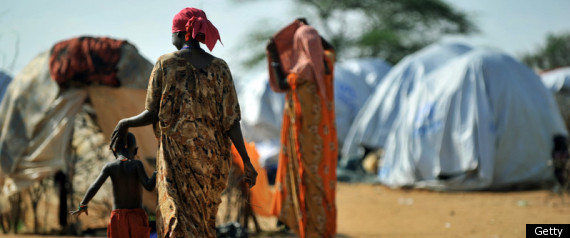
When Al Jazeera's staff met Ibrahim Aden in Kenya's Dabaab refugee camp, he had just lost his one-year-old son. Five days earlier, he had buried another of his sons. A third child, sick and exhausted, was taking shelter in a nearby tent.
At least 450,000 Somalis have crossed the country's border with Kenya in recent months, fleeing one of the worst famines East Africa has seen in decades. For many, help came too late. US officials estimate that more than 29,000 children under the age of five have died in the crisis. Tens of thousands Somalis have been killed, and at least 250,000 people are still facing the threat of starvation.
In the first episode of its new season, Al Jazeera's Fault Lines traveled to Somalia to investigate why saving the famine-stricken region has proven so difficult.
Somalia faces four harsh realities, Fault Lines explains; the most severe drought Eastern Africa has seen in 60 years; 4 million people facing starvation; Al Shabaab militants, who control large parts in the south and center of the country, blocking aid from reaching those in need; and huge travel distances for those seeking aid. "Access to the crisis is so bad that the UN says it doesn't know how many people died," Al Jazeera notes. "But it's certainty in the tens of thousands, most of those children."
Why did the international community fail to see the crisis coming? How are international regulations on aid distribution affecting the response to the crisis, and does U.S. counterterrorism policy influence the distribution of aid in Somalia?
Watch the full first episode of Fault Lines below to learn more.

Fault Lines - Horn of Africa Crisis: Somalia's Famine 

Somalia: UN strongly condemns seizure of aid agency assets by insurgent group


Somali refugees, fleeing fresh violence in their country, queue at a reception centre in Kenya
28 November 2011 –
Senior United Nations officials today voiced grave concern over the seizure by members of Somalia’s Al-Shabaab insurgent group of property belonging to United Nations agencies and several non-governmental organizations (NGOS) striving to alleviate the humanitarian crisis in the country’s south. Secretary-General Ban Ki-moon condemned the seizure “in the strongest possible terms,” saying that the “brazen” action prevented the relief organizations from providing life-saving assistance to those in need.
“The Secretary-General demands that Al-Shabaab vacate the premises and return seized property to the affected agencies and NGOs,” said a statement issued by his spokesperson. “He calls for the ban imposed today by Al-Shabaab against these humanitarian organizations to be lifted immediately.”
Valerie Amos, the Under-Secretary-General for Humanitarian Affairs, warned that any disruption of relief efforts threatens to undermine the fragile progress made in saving the lives of hundreds of thousands people affected by a severe food crisis caused by the devastating drought in the Horn of African earlier this year.
Famine conditions could return to some of the affected areas in Somalia if relief work is interfered with, Ms. Amos, who is also the UN Emergency Relief Coordinator, said in a statement.
She also called upon groups associated with Al-Shabaab to withdraw immediately from humanitarian compounds seized in the south-central regions of Bakool, Bay and Hiraan, and Lower Shabelle in the south, and to desist from any further actions which would threaten humanitarian operations and the safety of aid workers.
Humanitarian relief efforts have saved thousands of lives since the declaration of famine in a number of areas in July, but the situation in central and southern Somalia remains critical. Four million people are still in crisis and 250,000 face famine, according to the UN Office for the Coordination of Humanitarian Affairs (OCHA), which Ms. Amos heads.
Humanitarian organizations working in Somalia remain strictly neutral, with their only task being to save lives, she said, urging all parties to the conflict in Somalia to respect international humanitarian law.
Press reports indicated that Al-Shabaab had issued a statement banning 16 relief organizations, including several UN agencies, from working in areas under the group’s control, accusing them of “illicit activities and misconduct.”
Meanwhile, representatives of Somalia’s civil society attending a consultative meeting in the capital, Mogadishu, have expressed full support for an agreed roadmap on ending the country’s transition period and usher in stability and effective governance.
“I am very optimistic that your presence here is a major landmark and milestone,” said Augustine Mahiga, the Secretary-General’s Special Representative for Somalia at the end of the three-day civil society consultative meeting on ending the transition. “Civil society is the bridge between political differences. The power is in your hands – help us.”
The meeting brought together 60 representatives of religious leaders, clan elders, the business community, the diaspora, youth and women’s groups. It was facilitated by the UN Political Office for Somalia (UNPOS), and was also attended by representatives of the Transitional Federal Institutions (TFIs), the Puntland and Galmudug regional administrations, as well as the Ahlu Sunnah Wal Jama’a group.

News Tracker: past stories on this issue

UN relief chief urges clear rules on civil-military coordination in disaster response

 
Print Email ShareNew


Under-Secretary-General for Humanitarian Affairs Valerie Amos
30 November 2011 –
The United Nations relief chief has urged humanitarian organizations and national armed forces to jointly formulate regulations to guide their relationship during response to natural disasters and other emergencies to ensure that their respective competences complement each other. “We recognize there are many valuable things that militaries can do quickly, on a large scale, and in the most difficult of conditions during humanitarian emergencies,” said Valerie Amos, the Under-Secretary-General for Humanitarian Affairs, addressing a meeting of Qatar’s HOPEFOR Initiative, which promotes effective use of military assets in disaster relief operations.
“At the same time, the presence of military organizations can often make the work of humanitarian organizations more difficult, especially in highly politicized environments. Humanitarian organizations must maintain their core values of impartiality, neutrality and operational independence at all times,” Ms. Amos told yesterday’s meeting in the Qatari capital, Doha.
She stressed the need for humanitarian organizations and armed forces to reach a “common understanding of our respective roles and responsibilities, as well as our rules of engagement.”
Relief agencies should only request the use of military assets after all other options have been exhausted, she added.
“Humanitarian organizations within and outside the United Nations are faced with larger and more complex crises every year. Effective partnership is essential if we are going to rise to that challenge, and create a genuinely global humanitarian order – to meet the needs of an increasing number of people coping with emergencies around the world,” said Ms. Amos.
She met with Qatar’s Prime Minister Sheikh Hamad bin-Jasim bin-Jabr Al-Thani, as well as the country’s Minister of State for Foreign Affairs, Khalid Bin-Muhammad al-Atiyah, and discussed with them HOPEFOR activities, ways to strengthen partnership with Qatar, as well as the humanitarian situation in Syria, Yemen and Somalia.

News Tracker: past stories on this issue

Conflict now major cause for displacement in Somalia, says UN refugee agency


A young Somali refugee receives an injection at a reception centre in Kenya's sprawling Dadaab complex
29 November 2011 –
Insecurity and conflict due to insurgency is now one of the main causes for displacement in Somalia’s capital, Mogadishu, the United Nations refugee agency said today, warning that constant fighting is also hampering aid efforts in the country. “In Mogadishu, we noted a profound change in the root causes driving forced displacement,” said Andrej Mahecic, spokesperson for the Office of the High Commissioner for Refugees (UNHCR). “While drought accounted for the vast majority of displacement in the Somali capital during the first three quarters of the year, as of October we have seen 8,300 people displaced by conflict and just 500 displaced as a result of drought.”
In Mogadishu, we noted a profound change in the root causes driving forced displacement.
Mr. Mahecic told reporters in Geneva that conflict and military activity were also affecting people’s access to food in other areas in the southern part of the country such as Qooqaani, Tabta and Afmadow, where some 500 people, including children, have left their homes and are travelling by foot to the border town of Dobley, where a number of agencies are distributing food and providing assistance.
UNHCR said this movement of people has happened in spite of the heavy rains which have limited movement in the southern and central parts of the country, while also adding that many people are still reluctant to move, fearing ambushes or getting caught in the crossfire.
Somalia faces a dire humanitarian situation, having endured a drought and famine as well as continued fighting and heavy rains this year, all of which have aggravated the conditions of its estimated 1.46 million internally displaced persons (IDPs).
Conflict is also preventing UN agencies from delivering assistance. UNHCR, the UN Children’s Fund (UNICEF) and the World Health Organization (WHO) all expressed concern today about the announcement by insurgent group Al-Shabaab that it would permanently revoke work permissions to several UN organizations in parts in Somalia under their control.
UNICEF and WHO reported that their offices have been raided and occupied, and said they are currently assessing the impact of these actions on their work.
Fighting and insecurity is also affecting refugee camps in neighbouring Kenya, with UN staff reporting that they have been unable to assess the number and condition of new arrivals to the Dadaab complex. However, despite restrictions on movement, authorities have managed to complete an oral polio vaccination campaign for all refugee children less than five years of age.
UNHCR also reported that more than 360 refugees in the camp have been affected by cholera and acute watery diarrhoea, adding that efforts to enhance security measures are being taken so assistance can be delivered as soon as possible.
In addition, the agency said it would increase its efforts in the Dollo Ado camps in Ethiopia as there is a high rate of severe acute malnutrition among resident children under the age of five. In response, UNHCR and partners are expanding their wet feeding programme to all children up to the age of 10, and adding milk powder to porridge to boost nutrient levels.

News Tracker: past stories on this issue

SOMALIA: Resettlement of drought-displaced begins


humanitarian news and analysis

a service of the UN Office for the Coordination of Humanitarian Affairs
Aid agencies in Mogdishu have started a project to resettle thousands of drought-displaced Somalis (file photo)
NAIROBI, 29 November 2011 (IRIN) - Resettlement of tens of thousands of drought-displaced Somalis, most of whom had sought refuge in the capital, Mogadishu, is under way, with aid agencies organizing voluntary returns to several areas in southern Somalia, officials told IRIN.

“We started a project to resettle some 4,000 families [24,000 people] back to their homes in time for them to take advantage of what is left of the rainy season," said Mohamed Abdullahi Hussein, the director of the United Arab Emirates-Red Crescent Society (UAE-RCS)in Somalia.

Hussein said the agency was providing the returnees with food to last three months, shelter material and between US$100 and $150 per family.

The returns are voluntary, with most going to Bay, Bakool and Lower Shabelle regions of southern Somalia, Hussein added.

Abdullahi Shirwa, head of Somalia's National Disaster Management Agency (NDMA), said it was the government's policy to resettle all internally displaced persons (IDPs). "It is not realistic to maintain hundreds of thousands people in overcrowded IDP camps indefinitely. So the best option is to help return those willing to do so to their home areas."

Shirwa said NDMA had scheduled a meeting this week with aid agencies in Mogadishu to organize a programme of resettlement.

"We basically want to see who can do what," he said. "There are agencies that can provide the food; others can provide the transportation, while others can provide shelter material or cash incentives."

Since UAE-RCS began the return process in November, some 460 drought-displaced families have gone home.

"On 28 November we repatriated 261 families [1,566 people] back to Bay region," said Abubakar Sheikh Bashir, team leader for the UAE-RCS resettlement project.

He said many of the returnees, mostly farmers, were eager to take advantage of the best rains in three years "and restart their lives".

Bashir said many families have already returned on their own, "while others sent back the able-bodied and left behind the elderly, the women and children".

Bishaaro Haji Alin, 45, lost four of her nine children in the drought that devastated her home area in Buur Hakaba in Bay region.

"I was here in the camp for the last six months; if we did not come here I could have lost all of my children," Alin told IRIN by telephone, as she boarded a truck back home.

Alin said she was eager to start planting. "My children are fine and we want to go back to where we belong. We got help here but it is not home."

Home for Alin and her family, along with some 10,000 families, had been the sprawling Tribunka camp, the largest in Mogadishu.

Shirwa of the NDMA said the key to resettling the drought-displaced IDPs was to provide them with enough support to allow them to restart their lives.

"Most of the displaced are agro-pastoralists and so it is not enough to say we will give them food until the next harvest; we need to provide them also with some pack animals and maybe two or three cows or whatever animals they had before," Shirwa said, adding "that will not only empower them but help them start afresh."

ah/mw Theme (s): East African Food Crisis, Refugees/IDPs,
[This report does not necessarily reflect the views of the United Nations]