Saturday, February 23, 2019


Project PA | 60% of sex, human trafficking victims once involved in foster care system

Several
nationwide studies show as many as 60 percent of sex and human
trafficking victims in the United States were once in foster care.
(WJAC)
Several nationwide studies show as many as 60 percent of sex and human trafficking victims in the United States were once in foster care.
Brian Sheehan takes a look at the numbers and how they relate to victims in Pennsylvania for Project PA: Children in Crisis.
It may be hard for you to imagine. Many children involved with the foster care system finding themselves a victim of one of the worst types of crimes imaginable. Experts say sex trafficking is happening here in the United States in the shadows and is affecting our most vulnerable populations.
Children and youths in foster in Central Pennsylvania may find themselves targets for sex traffickers, according to Rhonda Hendrickson with the YWCA of Greater Harrisburg.
"Traffickers prey on those vulnerabilities in our children," Hendrickson said. "We have seen about 250 victims since 2014. Out of those, we probably have about 10 or 12 that are actually minors."
Hendrickson says a majority have some connection to the foster care system. But it's unclear how many of those adults were once in the system, too.
"It really is difficult to track. Human trafficking victims, whether it's a child or an adult, don't typically identify their own victimization," Hendrickson said.
According to the National Foster Youth Institute, 60 percent of all child victims nationwide have a history in the child welfare system. Many of them found during FBI raids of sex trafficking rings across the country.
Hendrickson says children and youths in foster care are easy targets since many lack the protective factors of other people their age.
"A mother and a father in the home. A stable home environment with stable housing. Other adults that care about you. Teachers, coaches, a good education," she said.
The institute states "flaws in the foster care system have led too many children into a life of exploitation and prostitution." Hendrickson says progress is being made in terms of tracking and preventing it from happening, more needs to be done before it's too late.
"We need to find a better way to get to them. Whether it's foster care workers understanding what trafficking looks like, Children and Youth agencies have been great in responding to human trafficking. But we really need people on the ground understanding what trafficking looks like," Hendrickson said.
What can foster parents do to prevent human trafficking?
Human trafficking is closely linked to children in foster care, and as a foster parent, it"s crucial to be educated on the topic so you can do your best to help prevent or stop it in its tracks. In this post, we"ll teach you what to look for and how to help fight the battle against human trafficking.
Right now, the YWCA is actually working to fight human trafficking in our area through a grant they received. It's one of the largest in the state. Hendrickson says the grant has allowed them to increase identification of victims by as much as 200 percent
Read more: https://wjactv.com/news/local/fire-crews-respond-to-burger-king-fire
Utah County human trafficking police operation funded by Adobe grant nets 41 arrests


“Day-to-day operations of the Special Victims Task Force do not include funding to regularly conduct detailed undercover operations such as these,” the UCSO said in a statement Thursday.
In February 2018, Homeland Security Investigations submitted a grant request to the Adobe Foundation in Lehi to help fund additional resources for the sheriff’s office to address the issue. The foundation has teams at Adobe Corporate Locations with employees who decide where grant funds should be focused in local communities.
The grants were approved, and through Operation Underground Railroad, the UCSO was able to fund equipment, training and operational expenses to conduct undercover human trafficking operations in Utah County. Operation Underground Railroad is an organization that fights to save children from human and sex trafficking.
The UCSO said they conducted an undercover operation in July 2018 using the training, equipment and funding from this grant, and as a result, they were able to identify a 16-year-old Utah County juvenile who was a victim of human trafficking. The UCSO said that the juvenile is now living with family and receiving services.
During the operation, deputies and officers with the Lehi Police Department placed an ad on social media, and 18 different people responded to the ad, reportedly arranging to meet with people they believed to be prostitutes. Of those 18 people, charges of prostitution, a class B misdemeanor, and patronizing a prostitute, a class A misdemeanor were brought. According to the UCSO, those who were charged with prostitution were cited and released, and those who were charged with patronizing a prostitute were arrested and booked into the Utah County Jail.
The Utah County Sheriff’s Office requested additional grant funding in January, which were approved.
Another undercover operation was conducted last week, and 23 additional people were either arrested or cited, bringing the total number of arrests from the operations to 41 individuals.
Two of those arrests were announced Wednesday.
David Moss, 51, of Lehi was booked into the Utah County Jail on suspicion of exploiting a prostitute, a third-degree felony and misdemeanor charges of sexual battery, patronizing a prostitute and two counts of lewdness.
Moss reportedly answered an ad for prostitutes, telling undercover officers that he would help “manage” them. When he met with undercover officers, he reportedly grabbed one’s hand and forced her to touch his genitals outside of his pants and then exposed himself to the officers.
Moss was an active bishop in a Lehi ward of The Church of Jesus Christ of Latter-day Saints, according to church officials. He has since been released from that position.
Also arrested as part of the operation was Richard Michael Martin, 29, of Riverton. Martin was booked into the Utah County Jail on nine counts of enticing a minor over the internet, all second-degree felonies.
Martin reportedly talked online to an undercover officer who he thought was a mother of 12- and 6-year-old girls. According to the UCSO, Martin told the officer that he wanted the young girls to perform oral sex on him and that he wanted to have other sexual contact with the 6-year-old girl.
The UCSO said Thursday that much of the evidence in the cases was collected using equipment and training that came from the grants from the Adobe Foundation.
“The Adobe Foundation and the Employee Action Teams at Adobe were crucial elements in Utah County Sheriff’s Office and Lehi Police Department being able to take these small steps toward eliminating human trafficking in our communities,” the UCSO said in a statement.

 China’s Muslims. A Uighur man makes traditional noodles at his food stand in Kashgar, China’s westernmost city that is home to a majority Muslim population. Like neighboring Tibetans, Uighurs have long faced religious oppression in China and many desire greater autonomy in the Communist state. (Photo by Sean Harder/The Stanley Foundation)  Oppression. Uighur woman walks past the Id Kah Mosque in Kashgar, the largest mosque in China where limits are placed on how the local Muslim population can worship. Moderate Central Asian Muslims like the Uighurs could play a cooperative role in the fight against terrorism but China’s repressive policies threaten to inspire new extremists. (Photo by Sean Harder/The Stanley Foundation) |
War on Terror or Misguided Muscle?
China’s underreported crackdown on Uighur Muslims could turn moderates into martyrs
The Uighur Muslims of Xinjiang, China’s westernmost, oil-rich province, have long endured religious oppression: from unexplained detentions to rules against facial hair.
This Turkic-speaking minority of about 8 million people were once the majority in Xinjiang, an expansive area of deserts and mountains that makes up one-sixth of China and serves as a frontier to central Asia.
Today, Uighurs struggle to maintain their cultural and traditional way of life in the face of a massive state-sponsored migration that has brought more than 1.2 million ethic Chinese settlers to the area. As the region’s energy resources are exploited, Xinjiang’s cities, like its capital Urumqi, are becoming modern metropolises. There is money to be made, but most opportunities fall to the Chinese settlers as native Uighurs are left behind.
While many Uighurs want greater autonomy—or even a separate state—they seem to have little desire, or leadership, for an organized violent rebellion. Yet, in the wake of the September 11 attacks in the United States, these moderate Sunni Muslims have borne the brunt of a little noticed Chinese religious crackdown.
“The worldwide campaign against terrorism has given Beijing the perfect excuse to crack down harder than ever in Xinjiang,” said Brad Adams, Asia director for Human Rights Watch. “Other Chinese enjoy a growing freedom to worship, but the Uighurs, like the Tibetans, find that their religion is being used as a tool of control.”
Prior to becoming part of China, Xinjiang was an independent Turkic state known as the East Turkestan Republic. In the 1930s and ’40s, the East Turkestan Republic twice managed to liberate parts of its territory from the Republic of China before acceding to the People’s Republican Army in 1949. The region was renamed the Xinjiang Uighur Autonomous Region under Chairman Mao Zedong in 1955.
In 1945 Uighurs constituted 80 percent of Xinjiang’s population. Today, incentives for Han Chinese to move into the providence have reduced the Uighurs to only 43 percent of Xinjiang’s population.
Terrorist Attack or Grudge?
The most visible crackdown in Xinjiang occurred in the run-up to the 2008 Olympic Games after two Uighur men drove a dump truck into a group of mostly Han Chinese policeman in the westernmost city of Kashgar. The men reportedly tossed explosives and attacked officers with knives, killing 17.
The Chinese government later released a statement claiming the attacks were an attempt to sabotage the games by the East Turkestan Liberation Movement, a Uighur separatist group with alleged ties to Al Qaeda.
Kashgar residents, however, have reported a different story to journalists, human rights workers, and two Stanley Foundation staffers who visited the city in November. The attack, they said, was organized by a vegetable salesman after police brutally beat his brother, who was attempting to collect back payments for vegetable deliveries to the local police station. The salesman and his accomplice have since been sentenced to death.
Understanding the truth behind such attacks, and the extent of the Uighur separatist movement, is important. Moderate Central Asian Muslims like the Uighurs could play a cooperative role in the global fight against terrorism. Yet repressive Chinese policies, and a lack of international concern, holds the potential of inspiring new extremists.
Little Attention Paid
While US-based human rights groups have called attention to recent crackdowns in Xinjiang, it rarely gets media or diplomatic attention.
In her first official visit to China earlier this year, Secretary of State Hillary Clinton chose to put aside the issue of human rights to discuss what she described as more pressing political and economic issues.
Uighur dissidents held by the United States at the Guantanamo Bay detention center have also become a troubling issue for the new Obama administration.
A federal appeals court has ruled the US government may continue to imprison the 17 Muslims even though it no longer considers them enemy combatants. The ruling comes after a lower court found no reason to hold them and ordered them released into the United States.
China is demanding the repatriation of the Uighurs, but human rights groups warn against the dangers of returning the detainees to the Chinese government.
The issue highlights just one of the complications the US war on terror has caused, said Atlantic writer James Fallows, who will end a three-year assignment reporting from China this year.
“This is one of the main areas the American 9/11 response had an effect on US-China relations,” Fallows said. “The US government was willing to define any Muslim group presumptively as part of the terrorist threat in the world, so it acquiesced to China’s view…of Xinjiang.”
Reports of Chinese efforts to suppress Uighur religion and culture are numerous. The US State Department, Amnesty International, and Human Rights Watch have recently condemned the treatment as a violation of international human rights standards.
A 2008 report by the State Department criticizes China’s use of “regulations restricting Muslims’ religious activity, teaching, and places of worship.” According to the report, religious institutions are strictly monitored, children are prohibited from religious education, Imams are regularly vetted to ensure their teachings support Chinese government authority, and passports are strictly controlled to prevent Muslims from pilgrimage travel.
Human rights groups have also documented cases of brutal beatings, detentions, and executions of Uighurs suspected of separatist activities.
While reports of religious repression might be similar to those that occur in Tibet, just south of Xinjiang, it rarely gets equal attention.
“Westerners have a sort of romantic view of Tibet and Tibetan Buddhism that they don’t have about Xinjiang Islam,” Fallows said. “I think that says more about the West than it does the differences between Xinjiang and Tibet.”
—Christina MacGillivray, Program Associate,
and Sean Harder, Program Officer,
The Stanley Foundation
and Sean Harder, Program Officer,
The Stanley Foundation
Editors Note: Christina MacGillivray and Sean Harder visited the Xinjiang cities of Kashgar, Turpan, and Urumqi in November of 2008 to explore the Uighur Muslim issue in China.
Convoy of civilians leaves final ISIL holdout in Syria

Trucks loaded with civilians leave last ISIL enclave in eastern Syria as US-backed forces wait to inflict final defeat.
![The SDF say a full evacuation of civilians is needed before they can launch a final assault on ISIL fighters in Baghouz [Rodi Said/ Reuters]](https://www.aljazeera.com/mritems/imagecache/mbdxxlarge/mritems/Images/2019/2/22/382d3d952de54b07819d80c126de3924_18.jpg "Convoy of civilians leaves final ISIL holdout in Syria")
Trucks carrying civilians left ISIL's last pocket of territory in eastern Syria on Friday hours after coalition air raids meant to pressure the fighters targeted the area on the banks of the Euphrates River.
Reporters near the front line at Baghouz saw dozens of trucks driving out full of civilians.
Most on board were women and children, although there were some men, their faces covered with chequered scarves.
The trucks were escorted by gun-mounted pick-up trucks belonging to
the US-backed Syrian Democratic Forces (SDF). As the convoy passed,
automatic gunfire could be heard in the distance and coalition aircraft
flew overhead.The final assault
The Kurdish-led SDF surrounding the patch of land has been unable to carry out a final assault on the last enclave held by the Islamic State of Iraq and Levant (ISIL, also known as ISIS) armed group because of the presence of the civilians.Some 300 ISIL fighters along with civilians believed to be mostly their families, according to The Associated Press news agency, have been under siege for more than a week in the tent camp in Baghouz, near the Iraqi border.
Reuters news agency says 7,000 civilians were also holed up with the fighters, citing Mustafa Bali, head of the SDF's media office.
As the trucks left the area, Bali told Reuters that thousands more civilians still remained inside the village.
A full evacuation of civilians was required to bring about a final defeat of ISIL in Baghouz, he told Reuters earlier on Friday.
"If we succeed in evacuating all the civilians, at any moment we will take the decision to storm Baghouz or force the terrorists to surrender," he said.
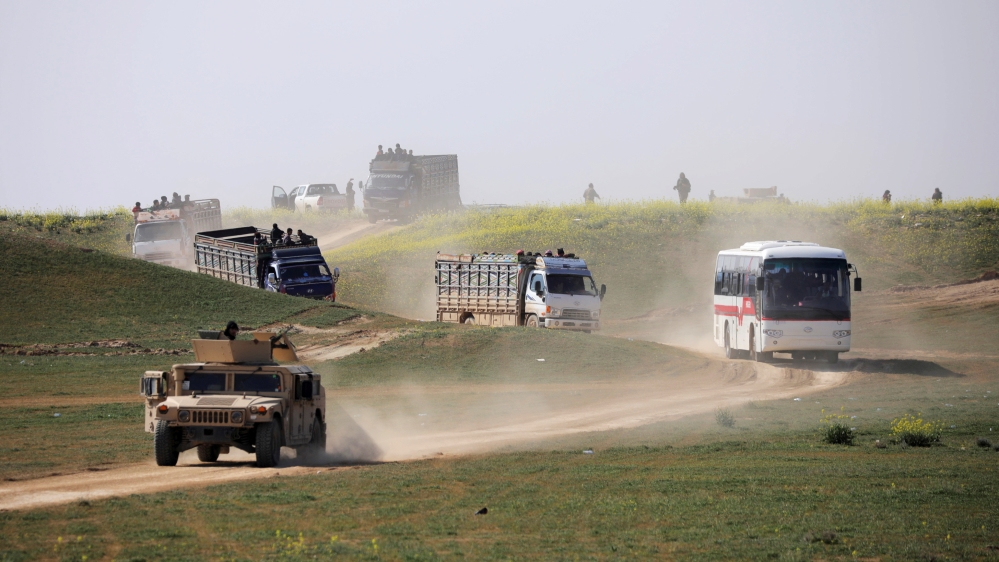 |
| Reporters saw dozens of trucks carrying civilians leave Baghouz on Friday [Rodi Said/ Reuters] |
The SDF hopes to complete the civilian evacuations by Saturday.
'Hungry and dirty'
In the past few weeks, nearly 20,000 people had left Baghouz through a humanitarian corridor, leaving the ISIL holdout on foot, but the fighters then closed the passage and no civilians left for a week until Wednesday, when a large group was evacuated.Bali said that screening had determined that most of those evacuated on Wednesday were not from Syria.
"The majority are Iraqi and from countries of the former Soviet Union, but there are also Europeans among them," he told AFP.
David Eubank, the leader of the Free Burma Rangers volunteer aid group, said the women and children trucked out were "very hungry and dirty".
They included "many French women", as well as others from Australia, Austria, Germany and Russia, and one woman from Britain, he told AFP.
Human Rights Watch urged the SDF and the US-led coalition supporting it to make protecting civilians a priority.
"Civilians leaving Baghouz is a relief but it should not obscure the fact that this battle appears to have been waged without sufficient consideration to their wellbeing," the New York-based watchdog's counterterrosim director, Nadim Houry said.
Recapturing Baghouz would mark an end to the territorial rule of ISIL's self-declared "caliphate" that once stretched across a third of both Syria and Iraq, but the armed group is still seen as a major security threat.
It has steadily turned to guerrilla-style warfare and still holds territory in a remote, sparsely populated area west of the Euphrates River - a part of Syria otherwise controlled by the Syrian government and its Russian and Iranian allies.
The United States will leave "a small peacekeeping group" of 200 American troops in Syria for a period of time after a US pullout, the White House said on Thursday, as President Donald Trump pulled back from a complete withdrawal.
Trump in December ordered a withdrawal of the 2,000 troops, saying they had defeated ISIL in Syria.
Subscribe to:
Posts (Atom)