Islam is the real positive change that you need to change for being a better person or a perfect human being, you can change yourself if you read QURAN, IF YOU DO THAT !! you will change this UMMAH, say I am not A Sunni or Shia, BUT I am just a MUSLIM. Be a walking QURAN among human-being AND GUIDE THEM TO THE RIGHT PATH.
Germany/Egypt: Agreement Risks Complicity in Abuses
Pact Could Tie Berlin’s Agents to Torture, Disappearances
(Berlin) – The German parliament should reject a proposed security agreement with the Egyptian
Interior Ministry, Human Rights Watch said today. The agreement, which
is scheduled for a vote on April 28, 2017, lacks human rights
protections and would be with a security agency whose officers have
committed torture, enforced disappearances, and most likely
extrajudicial killings. As a result, it could make German officials
complicit in serious human rights violations.
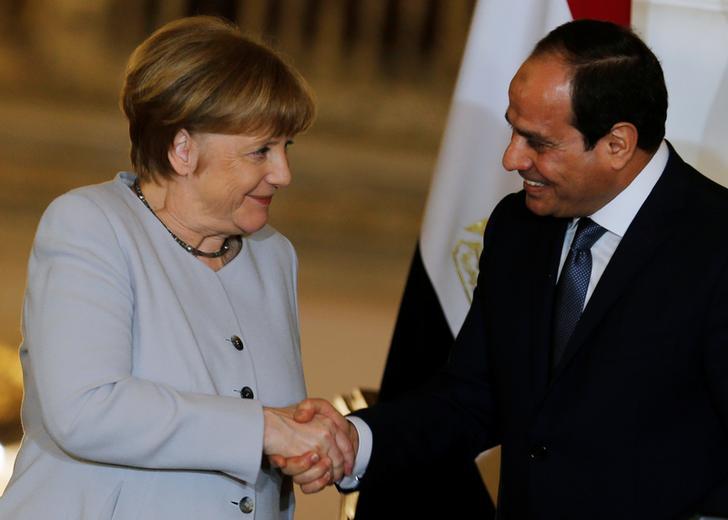
Egypt's President Abdel
Fattah al-Sisi and German Chancellor Angela Merkel shake hands following
a news conference at the El-Thadiya presidential palace in Cairo, Egypt
on March 2, 2017.
The agreement would establish cooperation in a number of fields most
important in combating terrorism. It obliges the authorities of both
countries to cooperate in investigations, share information about
suspects, and carry out joint operations. It includes only the vaguest
reference to “upholding human rights” and lacks any effective guarantee
that the major human rights abuses by Egyptian security agencies will
end.
“If the German government wants to help protect German and Egyptian
citizens from terrorism while respecting human rights, this is a
terrible way of going about it,” said Wenzel Michalski,
Germany director at Human Rights Watch. “The German government should
be getting cast-iron guarantees that Egypt is calling a halt to its
abuses, not rushing to put its agents next to Egyptian forces on the
front line of repression.”
Egyptian Interior Minister Magdy Abd al-Ghaffar signed the agreement with his German counterpart, Thomas de Maizière, in July 2016, but it remains subject to approval by the German Bundestag.
The agreement says it is aimed at combating terrorism and organized crime. It lays out 22 fields
in which various German authorities, including the Interior Ministry
and federal police, would cooperate with the Egyptian Interior Ministry.
They include preventing and combating corruption, human trafficking,
drug and weapons smuggling, and money laundering.
Under the agreement, Germany and Egypt would exchange experts on
crime prevention, share information on suspects and the structure of
criminal groups, carry out “operational measures” in the presence of the
partner government’s agents, and share staff and material to assist
“operational investigations.”
Egypt’s Interior Ministry has a decades-long history of arbitrary
arrests, enforced disappearances, and torture, in violation of both
international and Egyptian law and with little or no accountability.
Officers of the ministry’s National Security Agency, which has primary
responsibility for countering terrorism, have committed most of these
abuses, especially in cases in which detainees have been accused of terrorism, which Egyptian law defines broadly. The authorities regularly use allegations of terrorism to criminalize peaceful dissent.
President Abdel Fattah al-Sisi’s decision to impose a nationwide state of emergency in response to two Islamic State church bombings on April 9 expanded the National Security Agency’s already wide powers.
It allows the authorities to arrest and search suspects without
warrants, conduct limitless surveillance, censor any publication, seize
property, restrict public meetings, and set opening and closing times
for businesses. Perhaps most worrying, prosecutors can send cases to
Emergency State Security Courts, whose trials do not meet international
fair trial standards and whose rulings are not subject to appeal.
Egypt’s counterterrorism laws are drawn very broadly and used
against peaceful protesters and other political opponents who have faced
trial based on nothing more than the unsubstantiated testimony of
National Security agents. Most recently, prosecutors used them against a
human rights lawyer
who represented clients of police abuse. He was sentenced in absentia
to 10 years in prison for allegedly making threatening posts on his
Facebook page.
Egypt’s penal code defines terrorism broadly as “any use of force or
violence or any threat or intimidation to disturb public order or
jeopardize the safety and security of society, if it would harm or
spread terror among individuals or expose their lives, freedoms or
security to danger.” Terrorism can also include threats to “disrupt the
implementation of the constitution or laws.”
The requirements of the proposed agreement aimed at guaranteeing
cooperation in combating terrorism would almost certainly lead to German
security agents assisting the Egyptian National Security Agency, Human
Rights Watch said.
Since 1992, Human Rights Watch has extensivelydocumented the systematic use of torture by police and National Security agents to elicit confessions and punish detainees. In 2011, Human Rights Watch determined
that “the government is failing miserably to provide victims of torture
and ill-treatment effective remedy, or to deter such abuses from
occurring in the future.” Egypt’s inadequate legal framework for
punishing torture, the lack of an independent body to investigate the
police, and prosecutors’ near-total deference to National Security
agents have all contributed to this impunity.
The number of enforced disappearances and likely extrajudicial killings
by National Security agents has risen sharply since al-Sisi appointed
Magdy Abd al-Ghaffar as interior minister in March 2015. Most recently, Human Rights Watch documented
that National Security agents probably killed at least four and
possibly as many as 10 men in North Sinai whom they had forcibly
disappeared. The authorities then appeared to stage a fake
counterterrorism raid to cover up the killings.
The proposed agreement also runs counter to the European Union Foreign Affairs Council’s conclusions about Egypt in 2013, in the wake of the mass killings of at least 1,185 protesters
by Egyptian security forces. The council suspended export licenses to
Egypt for any equipment that might be used for internal repression and
decided to review all security assistance to Egypt.
In August 2014, Human Rights Watch concluded that the mass killings
of 2013, overseen by then-Defense Minister al-Sisi and primarily carried
out by Interior Ministry forces, probably amounted to crimes against humanity.
Human Rights Watch said that United Nations member countries should
suspend all security assistance to Egypt until the government adopted
measures to end serious human rights violations and hold violators
accountable, and should avoid complicity in abuses committed by Egyptian
authorities.
No government official or member of the security forces has been held accountable
for the killings, and prosecutors have opened no investigation. An
executive summary of a government fact-finding report released in
November 2014 did not recommend charges. Hundreds of people arrested
during the fatal protest dispersals in 2013 remain on trial on charges that include joining an armed group, killing security forces, and blocking roads.
The proposed agreement also contains troubling provisions on
information sharing. It does set rules for protecting personal data and
states that the agreement is not meant to provide information “to be
used as evidence in criminal proceedings.” But the agreement would
require the partner agencies to inform each other – verbally in urgent
cases – when one agency requests information “about the particulars of
those involved in criminal offenses, structures of offender groups and
criminal organizations and the links between them” and to help “track
down the offenders.” This provision raises the possibility that the
Egyptian Interior Ministry will use its German partners to obtain
information about political opponents who have not committed a crime.
The agreement also appears to encourage voluntary sharing of
information “which may be of importance to track down” terrorism
suspects in the absence of a request.
Despite the reference to “upholding human rights,” the agreement
states clearly that cooperation will be governed by each country’s
respective national law and makes no reference to international law
regarding arbitrary arrests, torture, enforced disappearances, or
extrajudicial killings. The fact that no National Security officer has ever received a final conviction for torture or ill-treatment shows that Egyptian national law has proven inadequate for preventing these abuses.



No comments:
Post a Comment