Islam is the real positive change that you need to change for being a better person or a perfect human being, you can change yourself if you read QURAN, IF YOU DO THAT !! you will change this UMMAH, say I am not A Sunni or Shia, BUT I am just a MUSLIM. Be a walking QURAN among human-being AND GUIDE THEM TO THE RIGHT PATH.
(Moscow) – Russia’s
Supreme Court ruled on April 20, 2017 that the Jehovah’s Witnesses
organization should be closed down and no longer allowed to operate
legally in Russia, Human Rights Watch said today. The ruling, which
affects more than 100,000 Jehovah’s Witness worshippers across Russia,
is a serious breach of Russia’s obligations to respect and protect
religious freedom.
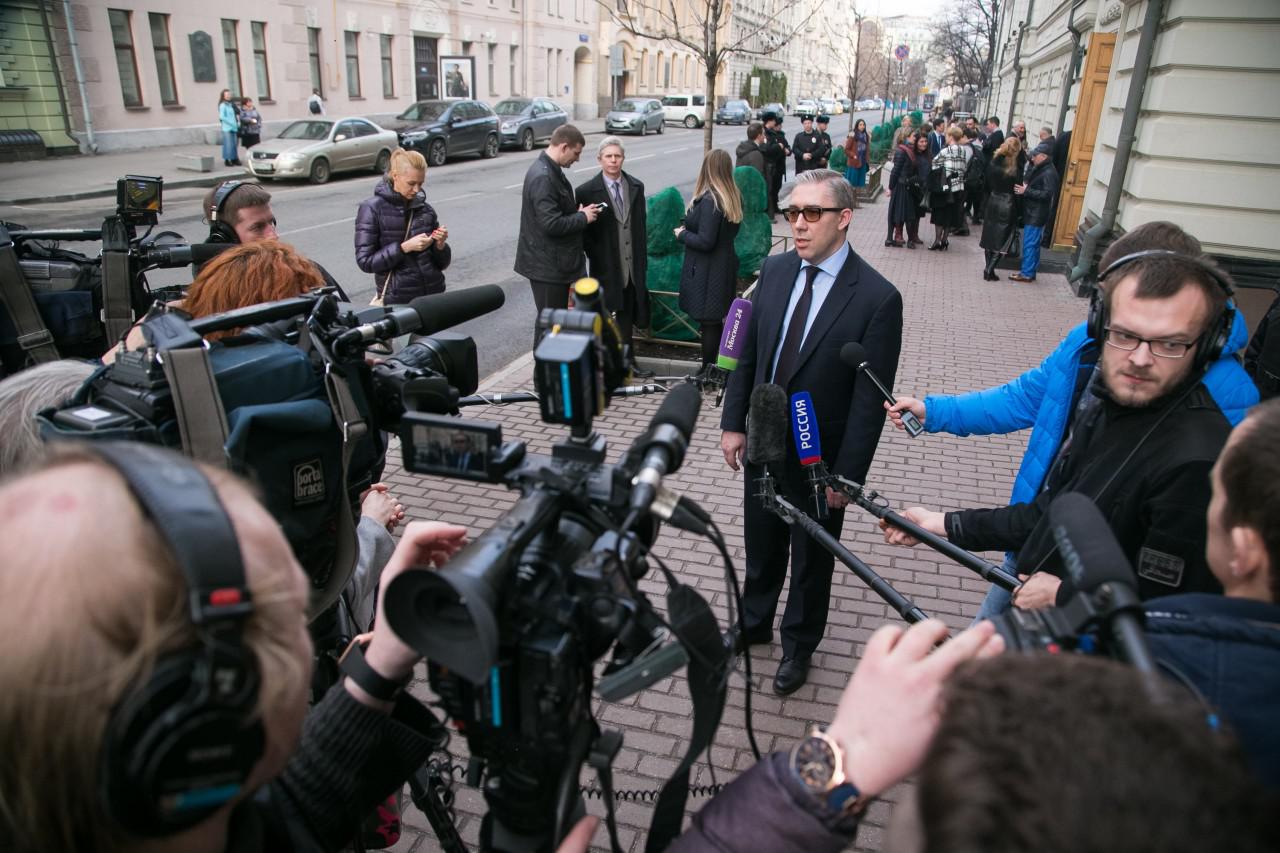
Yaroslav Sivulsky, member
of the managerial center of the Jehovah's Witnesses, gives an interview
after the court hearing in the Supreme Court on April 7, 2017, Moscow.
The Justice Ministry, which had petitioned the Supreme Court to
close the Jehovah’s Witnesses organization, should withdraw the case and
refrain from taking further measures that violate its obligations to
respect the Jehovah’s Witnesses organization’s right to freedom of
religion and to association. The Jehovah’s Witnesses organization said
it will appeal the ruling to the European Court of Human Rights.
“The Supreme Court’s ruling to shut down the Jehovah’s Witnesses in
Russia is a terrible blow to freedom of religion and association in
Russia,” said Rachel Denber,
deputy Europe and Central Asia director at Human Rights Watch.
“Jehovah’s Witnesses in Russia are now given the heartrending choice of
either abandoning their faith or facing punishment for practicing it.”
The ruling declares the Jehovah’s Witnesses Administrative Center an
extremist organization, closes the organization on those grounds, and
bans all Jehovah’s Witnesses’ activities. The Jehovah’s Witnesses
Administrative Center is the head office for 395 Jehovah’s Witnesses
branches throughout Russia.
If the ruling enters into force, people who continue to be involved
with Jehovah’s Witnesses organization or their activities in Russia
could face criminal prosecution and punishment ranging from fines of
300,00 to 600,000 rubles (US$5,343 to $10,687) to a maximum of six to 10
years in prison. People found to be leading such activity would face a
maximum 10 years. The organization’s property will be confiscated.
Jehovah’s Witnesses will not be able to congregate for worship at their
church or anywhere else.
World Report 2017: Russia
In Russia, the government in 2016 further tightened control
over the already-shrinking space for free expression, association, and
assembly and intensified persecution of independent critics.
According to the Justice Ministry,
since 2007, local courts have banned at least eight local Jehovah’s
Witnesses organizations, and 95 pieces of Jehovah’s Witnesses’
literature have been banned and placed on the federal registry of banned
extremist materials. In most cases the ban was triggered by claims in
the literature of the superiority over other religions of the Jehovah’s
Witnesses’ interpretation of the Bible. Anyone found with large
quantities of Jehovah’s Witnesses’ banned materials can be held
responsible for the misdemeanor offense of distributing “extremist”
materials.
The Justice Ministry case followed an unannounced inspection,
started in February 2017, of the Jehovah’s Witnesses Administrative
Center in St. Petersburg. The inspection found that the Administrative
Center had continued to fund branches that had been closed after a court
banned them for extremism. It also found the organization had taken no
action to change “extremist” literature and had continued to distribute
it. Jehovah’s Witnesses have vigorously denied the latter allegation.
The Justice Ministry suspended all Jehovah’s Witnesses’ activities when
the ministry filed its lawsuit on March 15.
A member of the Council of Europe and a party to the European
Convention on Human Rights, Russia is obligated to protect freedom of
religion and association. It has previously been found in violation of
multiple obligations under the European Convention on Human Rights for
actions taken through the courts to dissolve communities of Jehovah’s
Witnesses (Jehovah’s Witnesses of Moscow v. Russia, application no. 302/02).
The April 20 ruling to close the Jehovah’s Witnesses is a direct
interference with freedom of religion, effectively denying its followers
the right to worship, and cannot be justified as either necessary or
proportionate. The closure order directly violates the pluralism of
thought and belief that is foundational to a democratic society and as
the court has repeatedly affirmed, is “at the very heart of the
protection which [the convention] affords.”
“It’s not too late for the Russian authorities to make right this
serious move against religious freedom,” Denber said. “The Justice
Ministry should withdraw the suit against the Jehovah’s Witnesses
organization and stop interfering with group’s peaceful religious
activity.”



No comments:
Post a Comment