

August 8, 2012 -- Updated 1228 GMT (2028 HKT)
Using bikes to generate electricity
STORY HIGHLIGHTS
- 589 million people in Africa live without access to a public electricity facility
- Nuru Energy has created a pedal generator that allows light and mobile phone recharging
- The company says its products are more affordable and reliable than other energy solutions
- It has set up a network of micro entrepreneurs who sell and recharge the lights
Unplugged from the power
lines, households in these areas rely mainly on fuel-based devices such
as kerosene lamps for access to light. Such lanterns, however, are
polluting and costly: They emit toxic fumes, pose fire hazards and also
put a strain on family budgets.
But recently, an
innovative solution has emerged to offer affordable and efficient
electricity to low-income households while benefiting the communities by
providing jobs to local populations.
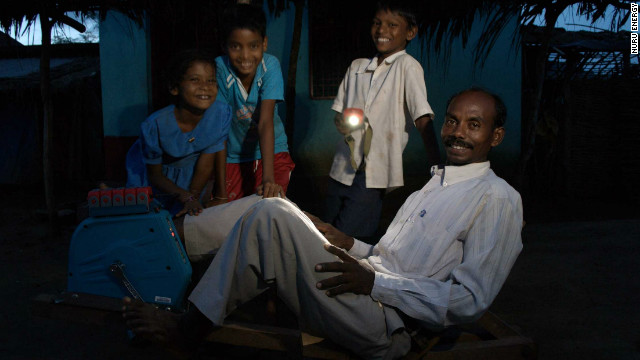
Called POWERcycle, Nuru Energy says it has developed "the world's first commercially available pedal generator" -- a foot or hand-powered device
that can recharge up to five modular light emitting diode (LED) lamps
in approximately 20 minutes, as well as power mobile phones and radios.
The company says each of its portable LED lamps
provides one week of light to a rural household. It also claims that
its products are more affordable and reliable than other forms of
off-grid offerings that have been developed in recent years, including
solar lamps or home solar lighting systems.
"We looked around and
said, well, what is the one energy resource that's untapped in this
environment? And human power really came to mind," says Sameer Hajee,
chief executive and co-founder of Nuru Energy.
Lighting up rural Africa
"We thought, well, if we
can harness human energy in a way that we can create economic
opportunity and low-power electricity, wouldn't that be a game changing
solution?"
According to Lighting Africa,
a joint World Bank - IFC program developed to increase access to clean
sources of energy for lighting, 589 million people in the continent live
without access to a public electricity facility.
It's a huge value proposition for the customer and for the entrepreneur.
Sameer Hajee, Nuru Energy
Sameer Hajee, Nuru Energy
The group says
African poor rural households and small businesses pay $10 billion per
year for lighting purposes, while communities not connected to the grid
spend $4.4 billion annually on kerosene.
Looking to address the
issue of energy poverty, Hajee, a social entrepreneur with a lot of
experience in international development, spent more than a month in
Rwanda in 2008, trying to figure out what were the energy needs of the
country's off-grid population.
What he found out was
"actually quite basic [energy needs]," he says. "It's light, it's
cooking, it's mobile phone recharging and radio."
Read also: Unplugging from the world's power lines

Life in Rwanda on two wheels

Rwanda's first professional cycling team

Cycling the rainy roads of Rwanda
With help from the World Bank, Hajee co-founded Nuru Energy and in 2009 the company started testing its products in the field.
Hajee quickly realized,
however, that innovative technology was not enough for the project to be
successful in a place like rural Rwanda. His company also needed to
adopt a creative approach in the distribution front.
Read also: Rwanda's B-Boys
"We couldn't just sell
product -- we had to actually get involved in the value chain
downstream," he says. "We thought, well, if the generator can recharge
five lights so quickly, could this not be the basis of a recharging
business for a local entrepreneur?"
As a result, the company
decided not to sell its products directly to customers. Instead, it set
up a network of village-level entrepreneurs who are responsible for
marketing, selling, and recharging the lights.
Hajee says this unique model of distribution has revolutionized the lives of both micro-entrepreneurs and customers.
"If you look at this
from the standpoint of the customer," says Hajee, "they would purchase
the light for $6 and then they would pay about 20 U.S. cents per week
for lighting. This is compared to about $2 a week that they would spend
on kerosene before. So it's 10 times cheaper solution for them.
"From the entrepreneur's
perspective, in 20 minutes of pedaling, they're recharging five lights,
earning about $1 -- any of us that work in Africa know that that's much
more than people make in an entire day. So it's a huge value
proposition for the customer and for the entrepreneur."
Hajee notes that this
model can easily be emulated across rural Africa. He says that Nuru
Energy, which currently focuses on East Africa and India, has already
been approached by a number of potential joint venture partners to roll
out the project in other parts of the continent.
"I really hope that what
we're providing here is a stopgap solution to the immediate energy
needs of...rural populations," says Hajee. "What I would really hope is
that, you know, there's certainly effort needed in providing grid
quality electricity to these populations. It'll take some time."


No comments:
Post a Comment