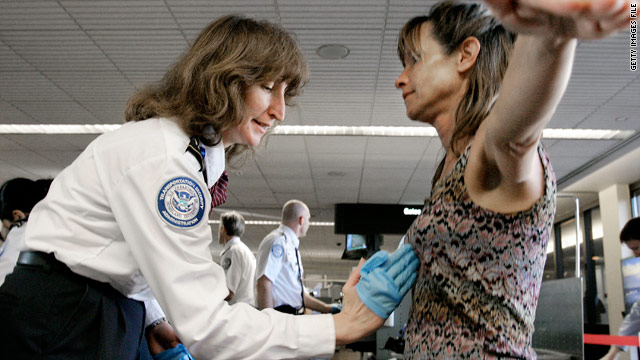

The airport security process, considered an inconvenience at best and at worst a personal invasion, is fait accompli for travelers these days. No one likes it, but everyone who wants to fly – and fly safely – gets in line.
Now a group that represents the world's largest airlines is claiming it doesn't always have to be this way.
"We must replace a 40-year-old concept with a risk-based approach, powered by intelligence and technology," said Giovanni Bisignani, director general of the International Air Transport Association (IATA), in a speech to the trade group's members. "Our passengers should be able to get from the curb to the gate with dignity, without stopping, without stripping, without unpacking and certainly without groping."
IATA unveiled its aptly dubbed "Checkpoint of the Future" at this week's annual general meeting in Singapore. Although the project is still nothing more than a concept, the mock-up showed a fully automated security system. Passengers are able to confirm their identity with a passport and iris scan alone, and then proceed down a tunnel.
While they walk, the system performs all the normal safety checks, including an X-ray, liquid scan, shoe scan and explosive detector: all without the need to stop and remove your laptop.
The idea also includes multiple paths for different types of travel. Those who regularly take to the skies could apply for the "known traveler" status, which would reduce screening significantly for each trip. Those considered a high risk would enter a tunnel with an enhanced set of checks. Even if a passenger sets off a detector, IATA said he or she would just be diverted to another automated check, not a manual pat down.
The "Checkpoint of the Future" sounds a bit like concept car – great fun at the auto show, but not showing up in the driveway anytime soon.
However, Ken Dunlap – head of security for IATA – insisted that the system “is science fact and not science fiction.” He said he expects the new checkpoints to be implemented in the next five to seven years.
Despite his optimism, Dunlap was vague when asked about the overall cost of the project, and putting such technology to work would take sustained collaboration by the airline industry, airport operators and participating governments.
As airline passengers today face an ever stricter web of security restrictions, the "Checkpoint of the Future" provides the promise of a pat-free check-in: A promise that may or may not provide much comfort next time you get pulled out of the security line.


No comments:
Post a Comment